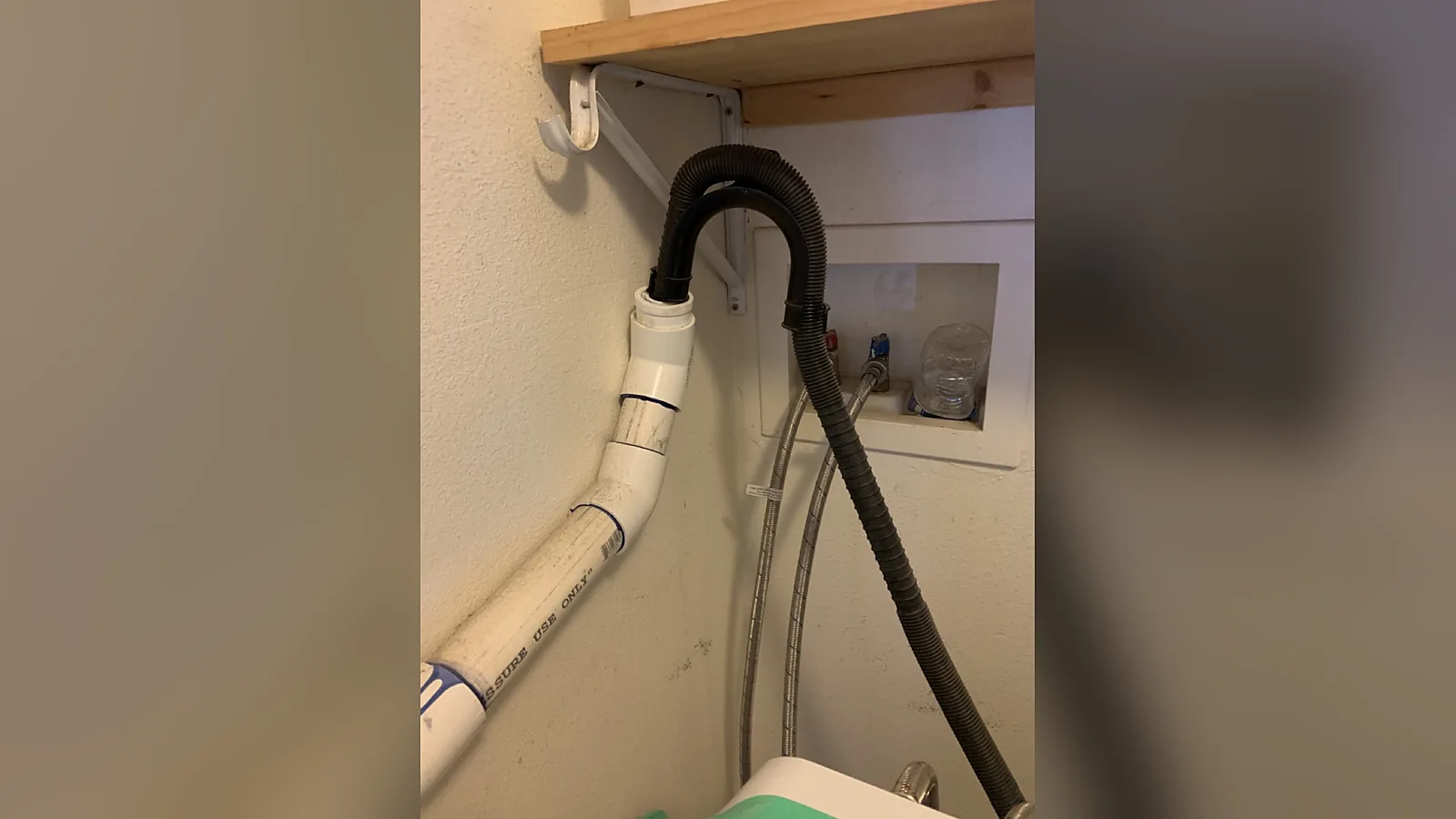
Short answer: A washing machine leaking from the bottom usually has one of five causes: a leaking inlet hose, a torn front-load door boot, the drain pump or its filter cap, an overflowing standpipe, or excess suds. Shut off the water valves, then match the puddle's location to the cause. Most fixes are free or $170–$420 in Los Angeles.
This guide is for anyone who just found water under the washer, in a garage, a laundry closet or a condo with neighbors below. It covers the first five minutes, how to trace the leak, what you can fix yourself and what repairs cost in Los Angeles.
What should you do first when a washer leaks?
Stop the water and the power before you look for the cause. A leaking supply hose can burst, and the house feeds it at full pressure until the valves are closed.
- Turn off both water valves behind the washer. Lever handles are off when they sit crosswise to the pipe; round handles turn clockwise.
- Unplug the washer. If water has reached the outlet or the cord, switch off the washer's breaker first and keep wet hands away from the plug.
- Dry the floor, the bottom edge of the cabinet and the hoses so new water shows clearly.
- In a condo or apartment, tell the building manager or the neighbor below; water travels farther than it looks.
Where is the water coming from?
Where the puddle forms, and when in the cycle, usually identifies the leak before any panel comes off.
| Where you find water | When it shows up | Likely cause | Fix and typical LA price |
|---|---|---|---|
| Behind the washer, at the hose fittings or the wall valves | During fill, or even with the washer off | Loose fitting, worn hose washer or split inlet hose | Tighten or replace the hoses yourself; a wall valve leaking at its stem is plumbing work |
| Down the back of the cabinet, below the hose connections | During fill, sometimes constantly | Leaking or cracked water inlet valve | New inlet valve, $170–$300 |
| Front, under the detergent drawer | During fill | Clogged dispenser, or too much detergent overflowing the drawer | Clean the drawer and its housing; free |
| Below the door (front-load) | During wash and spin | Torn door boot, or laundry caught in the seal | Clean the folds, or a new door boot, $220–$420 |
| Bottom front, by the filter cover (front-load) | During drain and spin, or after the filter was cleaned | Filter cap not seated, or a cracked drain pump housing | Reseat the cap; new drain pump, $190–$340 |
| Behind the washer, out of the drain pipe | Only while it drains | Standpipe overflow from a slow or clogged house drain, or a hose that slipped out | Secure the hose; clearing the drain line is a plumber's job |
| Spread out in front, often with foam | Wash and rinse | Oversudsing from too much or non-HE detergent | HE detergent at the right dose; free |
| Under the middle, often rusty, with a roar on spin | Wash and spin | Failed tub seal, usually with worn bearings | Tub bearing and seal, $450–$750 |
Why is my washing machine leaking from the bottom?
Most leaks come from parts that wear: rubber hoses, the door boot, the drain pump and the tub seal. Each leaves its own signature.
Inlet hoses and the inlet valve
A drip that continues with the washer off comes from a hose, the wall valve or a cracked inlet valve body. A drip only during fill points to the inlet valve, the electric valve on the washer that lets water in, or the short hoses after it. Whirlpool's installation instructions say to replace inlet hoses every 5 years.
The door boot on a front-loader
The door boot is the rubber gasket between the door and the drum. Underwire and coins tear its lower fold, and a sock caught in the seal wicks water out. Torn rubber means a new boot.
The drain pump and filter
A front-loader's pump filter sits behind a small cover at the bottom front. A cap screwed in crooked after cleaning is a common leak, and so is a pump housing cracked by a coin.
The standpipe behind the washer
A standpipe is the open drain pipe the drain hose hooks into, as in this post's photo. If water spills out of its top during drain, the house drain can't keep up, often from lint in the line. Whirlpool calls for a standpipe at least 2 inches wide, with only about 4.5 inches of hose inside on its front-loaders (8 inches maximum on top-loaders), loose enough to leave an air gap.
Too many suds
High-efficiency washers use little water, so extra detergent becomes foam that pushes water out of the dispenser or door. Use HE detergent, measured for the load. LG notes that soft water makes detergent over-suds, so homes with a water softener need less, and Whirlpool warns that "no splash" bleach contains a thickener that can create excess suds.
The tub seal and bearings
A seal behind the drum keeps water out of the bearings that carry its shaft. When it fails, rusty water drips under the middle of the washer and the bearings start to roar on spin.
What can you check and fix yourself?
Most leak checks need only a flashlight and dry paper towels. Keep the washer unplugged while you inspect; plug it in only for a test once the floor is dry.
- Hoses: feel each fitting for damp spots and look for bulges. Hand-tighten loose couplings plus a quarter turn. Replace hoses over 5 years old, with new rubber washers.
- Dispenser drawer: pull it out, rinse it and scrub the crust from the housing.
- Door boot: fold back the lower lip and look for tears and trapped socks.
- Filter cap: open it over a shallow pan, wipe the threads and screw it in straight until it stops.
- Drain hose: secured in its clip so it can't jump out of the pipe, but not taped airtight.
- Paper-towel test: lay dry towels around the washer, run a rinse-and-spin cycle and watch which gets wet first, and when.
Stop there if water is near the motor, wiring or outlet, if the leak is inside the cabinet, or if a wall valve leaks at its stem or won't turn. Old valves can snap when forced.
Is a leaking washer worth repairing?
Usually yes: most leaks come from hoses, seals, valves and pumps that cost nothing or $170–$420 to fix. The exception is a failed tub seal: the fix includes new bearings at $450–$750, and on a washer past about 8 years replacement usually wins. Our rule: repair when the quote is under half the price of a comparable new washer and the washer has life left (roughly 10–12 years for mainstream washers).
When should you call a technician?
Call when the leak comes from inside the cabinet, the inlet valve, the pump, the door boot or the tub seal, or when a test cycle doesn't reveal the source. Keep the valves off until then.
Calls about active leaks are answered 24/7, and calls placed before noon are usually seen the same day across Los Angeles, Orange and Ventura counties. The washer diagnostic is $69, applied to the repair you approve, with the same fees in all three counties and no travel charge. Have the brand, the model number and where you found the water ready, then call (866) 696-7767 or book online. Related reading: why a washing machine makes a grinding noise (the tub-bearing story), LG washer error codes such as FE and Sud, and our washer repair service.
Frequently asked questions
Why does my washer leak only when it drains?
Water that appears only during drain and spin comes from the drain path: a loose front-load filter cap, a cracked drain pump housing, a split drain hose, or a standpipe that overflows because the house drain is slow. Watch the back of the washer while it pumps out; water rising out of the standpipe means the drain line, not the washer.
Can I keep using a washer that leaks?
Not until you know where the water comes from. A dispenser overflow or a loose filter cap is safe once fixed. A leaking hose or inlet valve can fail completely, and water near the motor or wiring is a shock risk, so keep the valves off and the washer unplugged until it's repaired.
Why is my front-load washer leaking from the door?
Usually the door boot, the rubber gasket around the opening. Laundry caught in its folds wicks water out during the wash, and underwire or coins can tear the lower lip. Clean the folds and check for tears with a flashlight. A torn boot needs replacing, typically $220–$420 in Los Angeles.
How much does it cost to fix a leaking washer in Los Angeles?
Most leak repairs run $170–$420: an inlet valve $170–$300, a drain pump $190–$340 and a door boot $220–$420. A leaking tub seal with bearings is $450–$750. The $69 diagnostic is applied to the repair you approve, and the price is in writing before work starts.
What's your washer doing?
Still not working? Call before noon and we can usually be there today.
- Diagnostic
- $69applied to the repair
- Same-day
- Call before noonMost LA, OC & Ventura calls seen today
- Warranty
- 30–90 daysparts and labor