Short answer: A microwave not heating while the light, fan and turntable still run usually has a failed high-voltage diode, magnetron or door switch, less often the capacitor or control board. First rule out demo mode and a door that isn’t closing firmly. The rest is technician-only: built-in repairs typically run $140–$480 in Los Angeles after a $69 diagnostic.
This guide is for anyone in Los Angeles County or Orange County with a built-in, over-the-range or drawer microwave that runs but leaves food cold. It explains what fails, what you can safely check from the outside, and why everything inside the cabinet is a job for a technician.
How does a microwave heat food?
A microwave heats food with a magnetron, a vacuum tube that produces the microwaves. A high-voltage transformer, capacitor and diode raise household power to the thousands of volts the magnetron needs, door switches cut that circuit whenever the door opens, and a relay on the control board switches it on when you press Start.
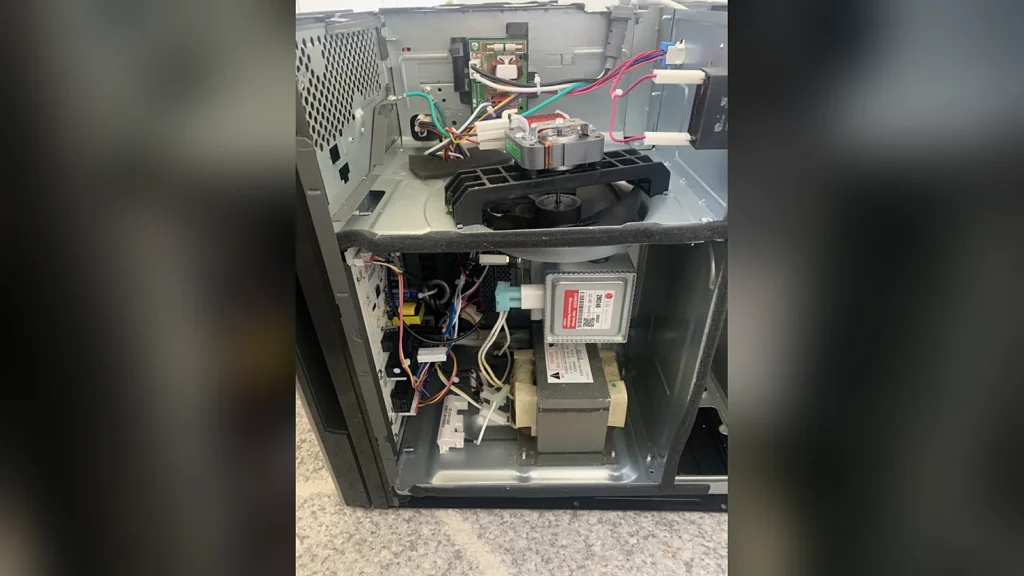
That split explains the most common symptom. If the light, fan and turntable all run but the food stays cold, the low-voltage side is working and the fault is in the high-voltage circuit or the switching that feeds it. The photo at the top of this page, from one of our service calls, shows that section in an over-the-range microwave: the magnetron is the silver box with the red warning label, the transformer sits below it and the control board runs down the left side.
What causes a microwave not to heat?
A microwave that runs without heating usually has a setting problem, a failed high-voltage diode, a worn magnetron or a bad door switch. These are the causes in the order technicians usually check them.
1. A setting, not a fault
Demo mode on some models lets you enter settings without turning on the magnetron, and a control lock (LOC, L or a padlock on the display) blocks cooking. A door that isn’t closing firmly, or a shipping spacer left in a new unit, keeps the high-voltage circuit off.
2. High-voltage diode
The diode is a one-way valve for electricity that works with the capacitor to feed the magnetron. A failed diode usually means a loud hum and no heat, and it often fails along with the magnetron, so the technician tests both.
3. Magnetron
The magnetron wears out with age and heavy use. A loud buzz, a burning smell or heating that fades over weeks all point to it.
4. Door switches and the main fuse
Every microwave has several door switches, also called interlocks. A worn switch can block the high-voltage circuit, and a failed switch can blow the main fuse, which leaves the microwave completely dead. Heat that only works when you press on the door is the classic sign.
5. Capacitor, control board relay or transformer
A shorted capacitor or a relay on the control board that no longer switches the transformer causes the same no-heat symptom. The transformer itself fails least often.
Causes, signs and typical prices
Most microwave repairs in Los Angeles County and Orange County cost $140–$520, parts and labor included, depending on which part failed. Typical prices after the $69 diagnostic:
| Cause | Signs | Fix | Typical LA price |
|---|---|---|---|
| Demo mode, control lock or door not closing | Display works, no heat | Turn the setting off; close the door firmly | No repair needed |
| Door switch or main fuse | Dead display, or heat only when the door is pressed | Replace the switch and fuse | $140–$240 |
| High-voltage diode or capacitor | Hum or buzz, no heat | Replace the failed part | $170–$300 |
| Magnetron | Loud buzz, burning smell, fading heat | Replace the magnetron | $260–$480 |
| Control board or relay | No heat, keypad acting up | Replace the board | $260–$520 |
| Drawer microwave fault | Any of the above on a drawer model | Diagnose and repair | $220–$560 |
What can you safely check yourself?
You can safely check a microwave’s settings, door and power from the outside, and nothing more. Never remove the outer cover: the high-voltage capacitor can hold a dangerous charge even after the microwave is unplugged.
- Turn off the control lock and demo mode. Look for LOC, L or a padlock on the display; your manual shows how to exit demo mode.
- Close the door firmly. On a new unit, remove the shipping spacer from inside the door.
- Run a water test. Whirlpool’s troubleshooting page suggests 1 cup (250 mL) of water on HI (100% power) for 1 minute; if the water is clearly warmer, the microwave is heating.
- If the display is dead, check the breaker and the outlet before anything else.
- Write down the model number, usually on a label inside the door frame, so the technician can bring the right part.
Stop using the microwave if it sparks, smells burnt, or the door is bent or won’t close firmly. The FDA advises never operating a microwave whose door doesn’t close firmly or is bent, warped or otherwise damaged. Our guide to what you can safely check before calling covers the other appliances in the kitchen.
Built-in, over-the-range and drawer microwaves
Built-in, over-the-range and drawer microwaves fail the same way inside, but they differ in how they come out for repair. An over-the-range microwave hangs from the wall and cabinet above the range and doubles as the range vent, so some repairs mean taking it down, a two-person job. Drawer microwaves sit below the counter, and drawer service typically runs $220–$560.
A microwave built into a wall-oven combination shares the cabinet with the oven. If the oven half has problems too, our oven repair page covers that side. When the turntable stops but the microwave still heats, see our guide to a microwave turntable that isn’t spinning.
Is a microwave worth repairing?
A built-in, over-the-range or drawer microwave is usually worth repairing; a countertop microwave usually isn’t. Replacing a built-in model means matching the opening or trim kit, and replacing an over-the-range unit means remounting it and reconnecting the vent, so a $140–$300 switch, fuse or diode repair is an easy yes.
A magnetron or control board on an older unit deserves a price comparison. Our rule: repair when the quote is under half the price of a comparable new unit, installed. Countertop microwaves are rarely worth a service call, and Pros Fix Appliances doesn’t service them.
When to call a technician
Call a technician when the outside checks don’t bring the heat back, and stop using the microwave if it hums loudly, sparks or smells burnt. The technician discharges the capacitor before testing the high-voltage parts and gives you a written quote before any work starts.
Pros Fix Appliances repairs built-in, over-the-range and drawer microwaves across Los Angeles County and Orange County. Calls placed before noon are usually seen the same day, and the $69 diagnostic is applied to the repair you approve, with no travel charge. Call (866) 696-7767 or book online.
Frequently asked questions
Can I fix a microwave that isn’t heating myself?
Only the outside checks: the control lock, demo mode, the door and a one-cup water test. The parts that usually fail, the diode, magnetron, capacitor and door switches, sit in the high-voltage section, and the capacitor can hold a dangerous charge after unplugging. Leave the cabinet closed and have a technician test it.
Why does my microwave hum but not heat?
A loud hum with no heat usually points to the high-voltage circuit: a failed diode, a shorted capacitor or a worn magnetron. Stop using the microwave, because running a faulty high-voltage circuit can damage other parts. In Los Angeles a diode or capacitor typically runs $170–$300 and a magnetron $260–$480.
Should I repair or replace an over-the-range microwave?
Repair it when the quote is under half the cost of a comparable new unit, installed. An over-the-range microwave is mounted to the wall and cabinet and vents the range, so replacement adds installation work. A door switch or diode ($140–$300) is usually worth fixing; a magnetron on an older unit deserves a price comparison.