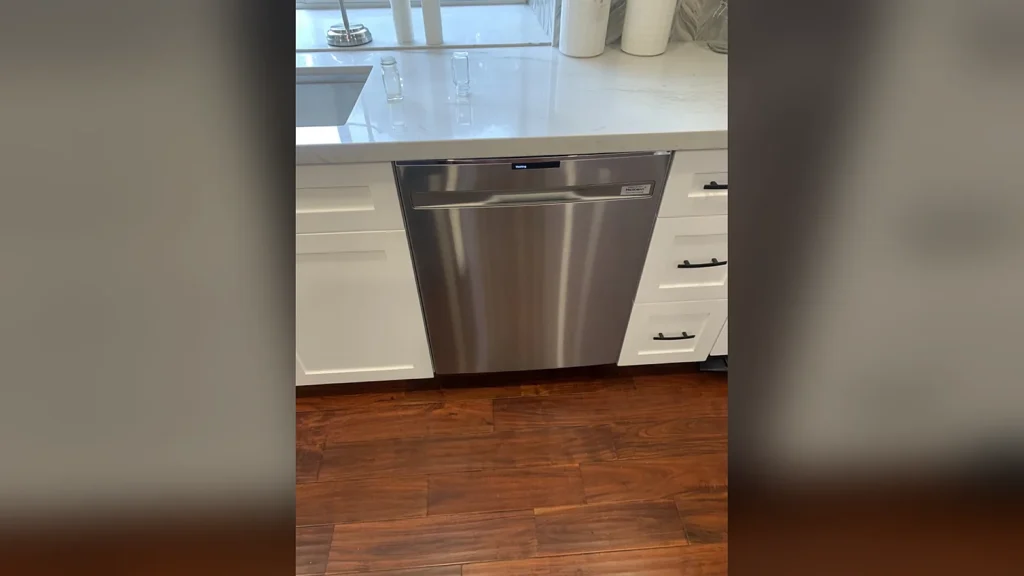
Short answer: A dishwasher not drying dishes is usually a setup issue: empty rinse aid, plastic items (which don’t hold heat), a heated-dry option switched off, or lukewarm supply water. Bosch dishwashers dry by condensation, so damp plastics are normal. If a heated-dry model’s dishes come out cool, the heating element may have failed — typically $220–$380 in LA.
This guide is for anyone unloading wet dishes, cups with water pooled on top, or damp plastic containers. It explains how your dishwasher dries (it changes the answer), the free fixes that solve most cases, the tells that mean something has actually failed, and what the repair costs in Los Angeles County and Orange County.
How does a dishwasher dry dishes?
One of two ways — heat or condensation — and the fix depends on which one yours uses. Check the manual or the dry options on the control panel if you’re not sure.
Heated drying
Many dishwashers, including Whirlpool’s, warm the tub after the final rinse with a heating element in the bottom of the tub. Some add a fan or vent, and some open the door a few inches at the end to let steam out (Whirlpool calls it Door Open Dry). Options such as Heat Dry, Pro Dry or Extended Dry control how long the heat runs.
Condensation drying
Bosch says all of its dishwashers dry by condensation, with no heating element at the bottom of the tub. The final rinse uses very hot water to heat the dishes; the stainless-steel tub cools faster than they do, so moisture condenses on the tub walls and drains away. Bosch calls it more energy efficient than a heating element, but it leans on rinse aid and on dishes that hold heat. Some Bosch models add CrystalDry, a mineral (zeolite) drying system with its own fan and heater. Some Miele models open the door automatically at the end of the program; Miele calls it AutoOpen.
Is it normal for plastics to stay wet?
Yes. Plastic doesn’t hold heat like glass or ceramic, so the water on it doesn’t evaporate, and Whirlpool notes that plastic and nonstick items may need a towel. On condensation-dry machines you’ll notice it more, because there’s no heater to help.
Put plastics on the top rack — Whirlpool says to keep them off the lower rack — angle them so water runs off, and use rinse aid. Miele adds that the drying phase may be too short for plastic and suggests the Extra dry option where your model has it.
What fixes a dishwasher not drying dishes?
Rinse aid, the right option and good loading fix most cases, at no cost. Try these in order before you book a repair:
- Fill the rinse aid. Whirlpool says rinse aid “greatly improves drying” by letting water sheet off the dishes; Bosch says it lowers the surface tension of water. If dishes are still wet with a full dispenser, raise the setting one step at a time — Miele warns that too much leaves a soapy residue.
- Turn the drying option on. Choose Heat Dry, Extended Dry (Whirlpool says it adds 15 minutes), Extra Dry or Sanitize, depending on your model. Some cycles skip drying entirely.
- Start with hot water. Run the kitchen tap until it’s hot before you start a cycle. Whirlpool wants at least 120°F (49°C) at the dishwasher, which takes longer to arrive when the water heater sits far from the kitchen — in a garage, for example.
- Load for drainage. Tilt cups, bowls and anything with a hollow base so water runs off; put glasses between the tines, not over them; don’t nest items.
- Wait, then unload from the bottom. On models without automatic door opening, Miele advises keeping the door closed for at least 15 minutes after the program ends. Then unload the bottom rack first, as Bosch and Miele both suggest, so the top rack doesn’t drip onto dry dishes.
- Deal with hard water. Spots and a dull film hold water. If your Bosch or Miele has a salt compartment, keep it filled and set the water hardness correctly. Our hard water and dishwashers guide covers the rest.
When is it a fault, not a setting?
When the dishes are cool and wet after a heated-dry cycle with rinse aid in, or when your dishwasher shows a drying-related code. The table shows the tells technicians look for.
| What you notice | Likely cause | Fix | Typical LA price |
|---|---|---|---|
| Everything wet, rinse aid light on | Empty rinse aid | Refill | Free |
| Only plastics wet | Normal — plastic doesn’t hold heat | Top rack, rinse aid, towel | Free |
| Dishes cool after a heated-dry cycle | Heating element or its thermostat | Replace the failed part | $220–$380 for an element |
| Wash water lukewarm, dishes not clean either | Heater, thermostat or a cool water supply | Test the heater and the supply temperature | $220–$380 for an element |
| Rinse aid level never drops | Rinse-aid dispenser not opening | Repair the dispenser or its control | Priced after diagnosis |
| Vent fan never runs at the end (models with one) | Fan motor | Replace the fan | Priced after diagnosis |
| Bosch shows E07 or E10 | CrystalDry fan (E07) or heater (E10) fault, per Bosch | Technician | Priced after diagnosis |
| Heater doesn’t come on at all, other parts test good | Control board | Replace the board | $260–$560 |
For a quick test on a heated-dry model, Whirlpool suggests running a 1-hour wash with Heat Dry selected — about 1.5 hours in total — and touching the dishes as soon as it ends. If they aren’t warm, the heating circuit needs service. With the power off at the breaker, you can also look at an exposed element: a visible break or blistered spot means it has failed.
What does a drying repair cost?
Most drying complaints cost nothing to fix. When a part has failed, our dishwasher diagnostic is $69 — trip, testing and a written quote — and it’s applied to the repair when you approve it. A heating element typically runs $220–$380 and a control board $260–$560 in Los Angeles County and Orange County, parts and labor, with the same fees in both counties and no travel charge.
Use the 50% rule: repair when the quote is under half the price of a comparable new dishwasher and the machine has life left — roughly 10–12 years for a mainstream model. An element on a six-year-old dishwasher is worth doing; a control board on a 12-year-old one often isn’t.
When should you call a technician?
Call when dishes come out cool after a heated-dry cycle with rinse aid in, when the wash water is cold too, when you see a damaged element, or when a drying code appears. If you smell burning or see a scorched element, switch off the breaker and leave it off. Calls placed before noon are usually seen the same day across Los Angeles County and Orange County; later calls are typically next business day. Call (866) 696-7767 or book online, and see our dishwasher repair service for what we fix.
Water left in the bottom of the tub is a different problem — see our guide to a dishwasher not draining.
Frequently asked questions
Why are my plastic containers still wet after the dishwasher?
Plastic doesn’t hold heat the way glass and ceramic do, so the water on it doesn’t evaporate before the cycle ends. Load plastics on the top rack at an angle, keep rinse aid filled, and use an extra-dry option if your model has one. A quick towel-dry is normal, especially on Bosch and other condensation-dry models.
Do Bosch dishwashers have a heating element for drying?
No. Bosch says all of its dishwashers use condensation drying: a very hot final rinse heats the dishes, and moisture condenses on the cooler stainless tub and drains away. That’s why rinse aid matters so much on a Bosch. Select models add Extra Dry, Sanitize or CrystalDry for better results.
Should I open the dishwasher door after the cycle to help it dry?
Give it time first. Miele advises keeping the door closed for at least 15 minutes after the program on models without automatic door opening, then unloading the bottom rack first so the top rack doesn’t drip on dry dishes. Models with an auto-open door handle this step for you.
How can I tell if my dishwasher heating element is bad?
On a heated-dry model, run a full cycle with the heated-dry option on and touch the dishes right away. If they’re cool, the heating element, its thermostat or the control isn’t heating. With the breaker off, look at an exposed element for a break or blister. A new element typically runs $220–$380 in Los Angeles.
Does rinse aid really help a dishwasher dry?
Yes, and on condensation-dry models it’s close to essential. Rinse aid lowers the surface tension of water, so it sheets off dishes instead of sitting in droplets, and it reduces spots. If dishes are still wet with a full dispenser, raise the setting one step at a time; too much leaves a residue.