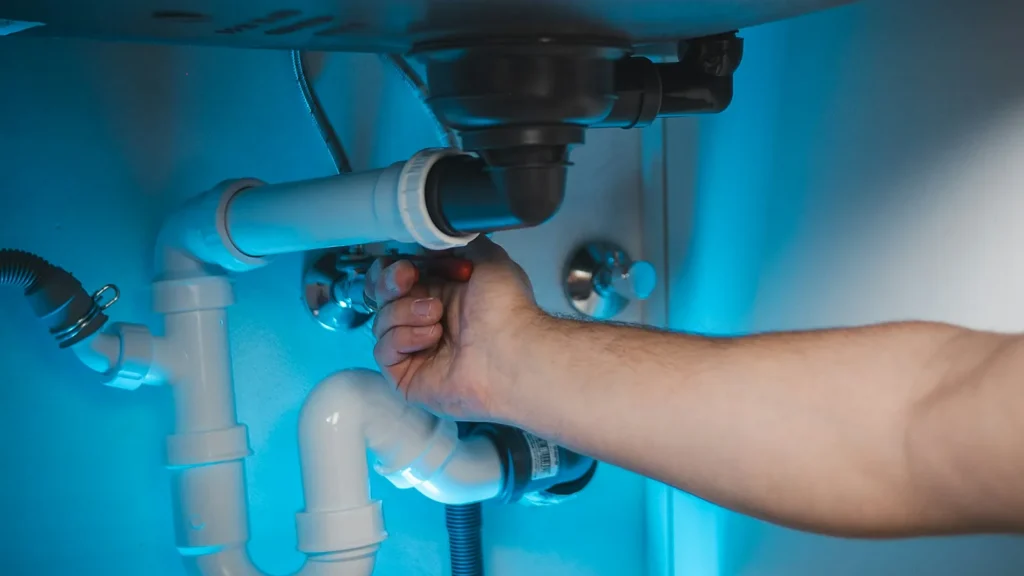
Short answer: A garbage disposal leaking from the bottom usually has a failed internal seal or a corroded housing, which can’t be repaired in place: the unit needs replacing, typically $320–$560 installed in Los Angeles. First dry everything and trace the drip, because leaks at the sink flange, dishwasher hose or drain pipe run down the unit and look like bottom leaks.
For anyone who opened the sink cabinet to a wet floor and a dripping disposal: how to find the real leak in about ten minutes, the three leaks that are cheap or free to fix, the one that isn’t, and what each costs across Los Angeles County and Orange County.
Where can a garbage disposal leak from?
A garbage disposal can leak from four places: the sink flange at the top, the dishwasher inlet on the upper side, the discharge outlet where the drain pipe attaches, and the bottom or body of the unit. Only a leak from the bottom or body usually means a new disposal.
| Leak point | When it drips | Usual cause | Fix and typical LA price |
|---|---|---|---|
| Sink flange (top) | When the sink is full or draining | Loose mounting or dried-out plumber’s putty | Reseat and reseal: $140–$220 |
| Dishwasher inlet (upper side) | When the dishwasher pumps out | Loose hose clamp or cracked hose | Tighten or replace the hose; reseal $140–$220 |
| Discharge outlet (side) | While the disposal runs or drains | Loose bolts or a cracked gasket | Tighten or replace the gasket: $140–$220 |
| Bottom or body | Even with the sink empty | Failed internal seal or corroded housing | Replace: $320–$560 (1/2–3/4 HP), $480–$780 (1 HP quiet) |
Not every puddle comes from the disposal: faucet supply lines, the P-trap or a sprayer hose can drip in the same cabinet. Those are plumbing repairs; we handle the appliance connections, not the house plumbing.
How do you find where the disposal is leaking?
To find a disposal leak, dry everything, then wet one connection at a time while you watch with a flashlight. The whole test takes about ten minutes.
- Cut the power. Unplug the disposal from the outlet under the sink or switch off its breaker before touching anything wet.
- Dry it and lay down paper. Towel off the disposal and the pipes and spread newspaper on the cabinet floor; a new drip shows as a wet spot. InSinkErator recommends the same trick on its disposal leak page.
- Test the flange. Plug the sink, fill it with a few inches of water and wrap a dry paper towel around the top of the disposal where it meets the sink. Wait five minutes. A damp towel means the flange.
- Test the drain side. Pull the plug and watch the joint where the drain pipe meets the side of the unit as the water runs out. Some discharge leaks show only while the motor runs; if it stays dry, restore power, run the disposal with cold water for 15 seconds, then cut the power again.
- Test the dishwasher inlet. Run the dishwasher’s shortest cycle and watch the hose connection on the disposal while the dishwasher pumps out.
- Check the bottom last. If every joint stays dry but water beads on the bottom of the unit, around the red reset button or along a seam in the body, the leak is internal.
Stop and call if water has reached the outlet or the cord, the breaker trips, you smell burning, or the disposal is wired into a junction box rather than plugged in.
The three disposal leaks you can fix
Leaks at a garbage disposal’s three connections usually need tightening, cleaning or a new gasket, and InSinkErator publishes a fix for each.
Sink flange
The disposal hangs from a mounting assembly under the sink drain. InSinkErator’s checklist for a leak there: the assembly is put together correctly, the locking ring is turned fully to the right, and all three mounting screws are evenly tight. On a new installation, too much plumber’s putty under the flange can keep it from seating. On an older one the putty dries out, and the fix is removing the disposal, cleaning off the old putty, setting the flange in fresh putty and remounting.
Dishwasher inlet
If the drip appears only when the dishwasher drains, tighten the hose clamp on the disposal’s inlet with the power off and look for a cracked or chafed hose; a split hose needs replacing. If the disposal is new and the dishwasher won’t drain at all, the knockout plug inside that inlet was probably never removed. InSinkErator says it has to come out before the dishwasher hose is connected.
Discharge outlet
Where the drain elbow attaches to the side of the disposal, loose bolts or a cracked gasket let water out while the unit runs. With the power off, tighten the bolts, clear debris off the gasket and replace it if it’s cracked, then check that the elbow-to-trap joint is tight. If a connection is corroded or still won’t seal, a technician reseal typically runs $140–$220 in LA, parts and labor.
Why does a leak from the bottom mean replacing the disposal?
A garbage disposal leaking from the bottom is leaking from inside the unit. Water from the bottom, around the reset button or through the body means the seal between the grinding chamber and the motor has failed, or the housing has corroded through.
Neither one is fixable in place on a household disposal. InSinkErator’s own leak guide offers no home fix for bottom, body or motor-joint leaks; it tells owners to contact the company. Once water reaches the motor, the bearings and windings are next, and the cord and outlet sit in the same wet cabinet.
Two checks before you buy. First, confirm the water isn’t running down from the flange or a pipe above, a point InSinkErator makes too. Second, check the warranty: InSinkErator’s disposal FAQ lists in-home limited warranties of 1–3 years on its Standard Series, 4–7 years on its Power Series and 8–10 years on its Quiet Series, and your model’s term is in its manual.
Out of warranty, a replacement installed across LA County and Orange County typically runs $320–$560 for a 1/2–3/4 HP unit and $480–$780 for a 1 HP quiet-series unit, and the new disposal comes with new seals and a fresh manufacturer’s warranty.
When to call a technician
Call a technician when the leak comes from the bottom or body, when a connection keeps dripping after you’ve tightened it, or when water has reached the outlet. Until then, keep the disposal unplugged and a bowl under the drip.
Pros Fix Appliances reseals disposal connections and replaces leaking units across Los Angeles County and Orange County. Call before noon and we can usually come the same day; later calls are typically seen the next business day. The $69 diagnostic includes a written quote and is applied to the repair or replacement, with the same fee in both counties and no travel charge. Call (866) 696-7767 or book online.
If the disposal also hums without spinning, start with the 5-step reset for a humming disposal. If the dishwasher won’t drain either, see our guide to a dishwasher not draining or our dishwasher repair service.
Frequently asked questions
Can you fix a garbage disposal leaking from the bottom?
Not in a lasting way. Water from the bottom or body of a garbage disposal means an internal seal has failed or the housing has corroded, and neither can be repaired in place. Replacement is the fix, typically $320–$560 installed in Los Angeles for a 1/2–3/4 HP unit.
Why does my garbage disposal leak only when the dishwasher runs?
That points to the dishwasher inlet: a loose hose clamp on the side of the disposal, a cracked hose or a damaged fitting. Tighten the clamp with the power off and replace a split hose. A technician reseal typically runs $140–$220 in LA.
Is a leaking garbage disposal dangerous?
It can be. Most disposals plug into an outlet inside the sink cabinet, so water on the cabinet floor can reach the cord and the outlet. Unplug the disposal or switch off its breaker before touching anything wet, and don’t run it until the leak is fixed.
Does plumber’s putty fix a leaking garbage disposal?
Only at the sink flange. Plumber’s putty seals the flange to the sink; it won’t stop a leak at the dishwasher inlet, the discharge or the body. If you’d rather not remove the disposal yourself, a flange reseal typically runs $140–$220 in LA, parts and labor.