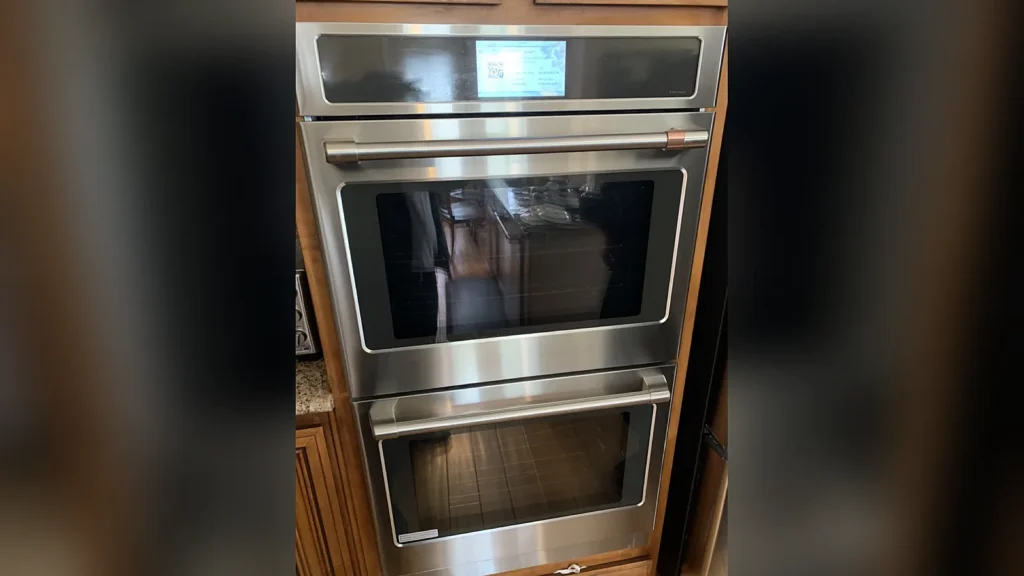
Short answer: GE oven F codes are fault codes from the electronic control. GE Appliances says F0, F1, F6 and F7 usually mean a keypad fault, F2 overheating, F3 and F4 the temperature sensor, F5, F8 and FF the control board, and F9 or FC the door lock circuit. Reset power once; if the code returns, call for service.
This guide is for anyone whose GE range or wall oven is flashing an F and a number or letter. Every meaning below comes from GE Appliances’ own support list, with what to check and the typical Los Angeles repair cost. Codes vary by model, so your owner’s manual has the final word.
What do GE oven F codes mean?
An F-code means the oven’s control has detected a fault in one of its circuits, and it usually shuts the oven down. GE groups the codes by the part that usually causes them, and the table below follows GE Appliances’ official oven code list.
| Code | What GE says it usually means | What to check first | Typical LA price |
|---|---|---|---|
| F0, F1, F6, F7 | A keypad (touchpad) problem; often the keypad needs replacing | Phantom beeps or dead pads; one power reset | Varies by model; quoted after testing |
| F2 or F20 | The oven got hotter than a preset limit, for a reason the code doesn’t identify | Let it cool fully, then reset once | Sensor $160–$280; relay or control board $280–$650 |
| F3, F4 | The oven temperature sensor usually needs replacing | The sensor and its wiring get tested | $160–$280 |
| F5, F8, FF | The electronic control usually needs replacing | One power reset | $280–$650 |
| F9, FC | A failed part somewhere in the door lock circuit | Door fully closed; nothing jammed in the latch | Quoted after testing |
| F350 | A fault in the upper cooling fan circuit, or something blocking the fan | Clear anything blocking the vents | Quoted after testing |
| F96, F97, F7X | An internal component usually needs replacing | One power reset | Quoted after testing |
| FD | The meat probe or its receptacle may need replacing | Unplug the probe and try a cycle without it | Quoted after testing |
“Usually” matters: a code points to a circuit, not a guaranteed part, and a loose connector can throw the same code as a dead sensor.
What do LOC, Bad Line, OFF and the other GE displays mean?
Most GE oven displays other than F-codes are settings you can clear yourself. Bad Line is the exception: the oven was wired incorrectly at installation.
- LOC or Loc On: Control Lockout (child lock) is on. On many GE models you hold the lock pad for 3 seconds to release it; check your manual for the pad name.
- LOC DOOR flashing without a self-clean: lockout is on, or the control needs GE’s LOC DOOR reset.
- A door message after self-clean: the latch didn’t release. See our guide to an oven door locked after self-clean.
- OFF when you set self-clean: the oven is still too hot. Let it cool and try again.
- ERR: an invalid keypad entry. Press Clear/Off and re-enter it.
- A backwards C (⊃): Sabbath mode is on, which can make the oven look unresponsive.
- Bad Line: the oven has power but is miswired; GE says an installer or electrician should correct it.
How do you reset a GE oven F code?
To reset a GE oven F code, press Clear/Off, let the oven cool, then cut power at the breaker for a minute or two. If the same code comes back, the fault is real and the oven needs service.
- Press Clear/Off (or Cancel) and write down the exact code.
- Let the oven cool. GE’s owner’s manuals say to allow one hour before putting it back into operation.
- Switch off the oven’s breaker (or fuse) for a minute or two, which GE says sometimes clears a code. Electric models run on 240 volts, so use the breaker and don’t open panels.
- Restore power, set the clock if it’s flashing, and run a normal bake.
- If the code returns, switch the breaker off again and leave it off until the oven is serviced, as GE recommends. GE notes you can switch it on briefly to use the cooktop, then off again.
Don’t keep resetting a code that returns, especially F2: each restart heats an oven the control has already flagged as running too hot.
F1, F7, F2, F3, F4 and F9 in detail
On a GE oven, F1 and F7 point to the keypad, F2 to overheating, F3 and F4 to the oven temperature sensor, and F9 to the door lock circuit.
F1 and F7: the keypad
The keypad (GE says keypanel) is the membrane of touch pads on the control panel. A failing one reads phantom presses or ignores real ones. Clean the panel with a damp cloth rather than spraying liquid onto the pads.
F2: oven over temperature
F2 means the control measured a temperature above its limit without saying why, so the technician checks the sensor, the relays that switch the heat, and the control. If F2 appeared during self-clean, let the oven cool completely first.
F3 and F4: the oven temperature sensor
The oven temperature sensor is a thin metal probe on the oven’s back wall whose electrical resistance changes with heat; the control reads it to know how hot the oven is. The technician tests the sensor and its connector, since a loose plug behind the oven can throw the same code.
F9 and FC: the door lock circuit
The door lock is a small motorized latch that holds the door shut during self-clean, plus switches that report its position. A failure there often stops the oven mid-clean or leaves the door latched; wait until the oven is cool, and never force the door.
GE oven F-code repair costs in Los Angeles
A GE oven temperature sensor typically costs $160–$280 to replace, and a relay or control board $280–$650, parts and labor included. Keypads (separate on some models, built into the control on others) and door locks are priced after testing.
The $69 oven diagnostic covers the trip, testing and a written quote, and it’s applied to the repair if you approve it. It’s the same across Los Angeles County and Orange County, with no travel charge. A GE gas oven that heats slowly or won’t light, with no code on the display, has a different problem; see our guide to an oven igniter that won’t light.
To decide, use the 50% rule: repair when the quote is under half the price of a comparable new oven and the oven has life left (around 15 years for ranges). Wall ovens tilt further toward repair, because a replacement has to fit the existing cabinet cutout. If your oven is still under GE’s own warranty, check with GE Appliances first; we’re an independent repair company, not a GE factory service center.
When to call a technician for a GE F code
Call when an F-code returns after one reset, when F2 appears outside self-clean, or when F9 leaves the door locked on a cool oven. A completely dark display is covered in our guide to an oven that won’t turn on.
Calls placed before noon are usually seen the same day across Los Angeles County and Orange County; later calls typically next business day. Give us the exact code and the model number. Call (866) 696-7767 or book online, or see our oven repair page.
Frequently asked questions
How do I clear an F code on my GE oven?
Press Clear/Off, let the oven cool, then switch its breaker off for a minute or two and back on. If the same code returns, the fault is real: leave the oven off at the breaker and book service.
Can I still use my GE oven while it shows an F code?
Not the oven. GE recommends keeping a range or wall oven off at the circuit breaker until it’s repaired. On a range, you can switch the breaker on briefly to use the cooktop, then switch it off again when you’re done cooking.
What does F7 mean on a GE oven?
GE groups F7 with F0, F1 and F6 as keypad faults, and says the keypad often needs replacing. Try one power reset. If F7 returns, or the pads beep on their own, a technician confirms whether the keypad or the control behind it has failed.
Is a GE oven with a control board error worth repairing?
Usually, if the oven is well short of about 15 years old and the quote is under half the price of a comparable new oven. A GE relay or control board typically costs $280–$650 in Los Angeles, and the $69 diagnostic gives you the written number to compare.