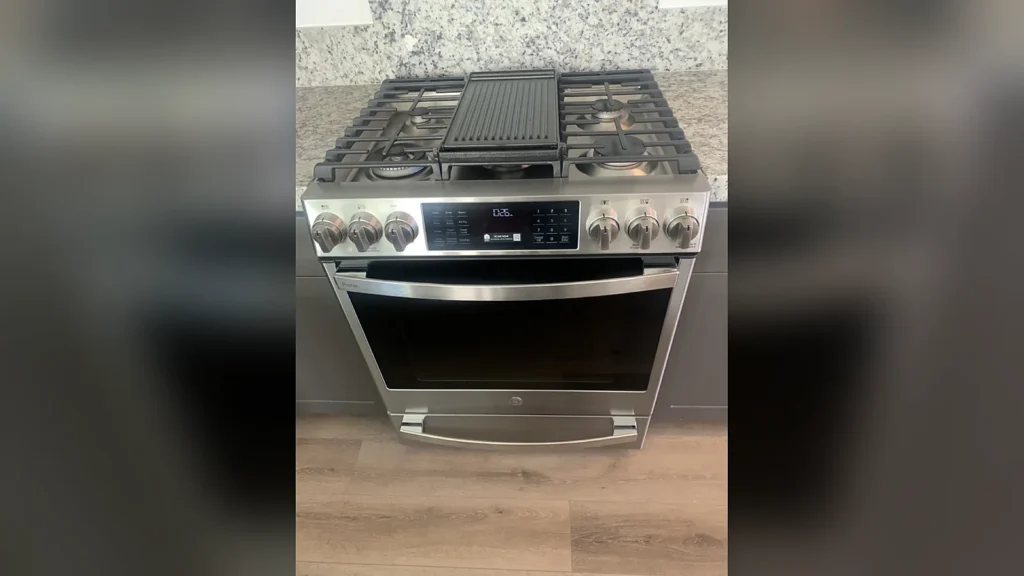
Short answer: An oven door locked after self-clean usually just needs time: the latch stays shut until the oven cools, roughly 30 to 90 minutes on GE’s slide-latch models. If it’s cool and still locked, cut power at the breaker for 30 seconds. If that fails, a lock motor, switch, thermal fuse or control has likely failed. Never force the door.
This guide is for anyone whose oven door stayed locked after a self-clean cycle, or whose self-clean won’t start. It covers how long the lock normally stays on, the safe reset that often releases it, which parts fail, self-clean safety and Los Angeles repair costs.
Why is my oven door still locked after self-clean?
A locked door right after self-clean is normal: the lock is designed to stay shut until the oven has cooled. It’s a fault only when the oven is cool and the door still won’t release.
Self-clean runs far hotter than baking, so a motorized latch (a hand-operated slide latch on older ovens) holds the door shut, and small switches report its position to the control. When a cool oven stays locked, the cause is usually one of these:
- The control needs a reset, often after a power blip during the cycle.
- The lock motor or a lock switch has failed, so the latch can’t move or the control can’t confirm where it is.
- A thermal fuse has opened. On many ovens this fuse protects against overheating; when it opens, the display goes dark and the lock has no power to release.
- The control board or a relay has failed.
How long does an oven stay locked after self-cleaning?
An oven door stays locked after self-cleaning until the oven cools. GE tells owners of its slide-latch ovens to wait roughly 30 to 90 minutes after the cycle before moving the latch, and ovens with a motorized lock release on their own once the control sees the temperature has dropped.
If the door is still hot outside, keep waiting; if it’s still locked an hour after the oven feels cool, try the reset below.
How do you get a locked oven door open safely?
To open a locked oven door safely, reset the control’s power, then follow your oven’s own release steps. Never pry, force or take apart the door; GE’s manuals warn that forcing the latch handle damages the door lock mechanism.
- Make sure the oven is cool to the touch, inside and out.
- Press Clear/Off or Cancel, then try the door once, gently.
- Cut the power for 30 seconds.GE’s instructions for a door that won’t release after self-clean start here: switch off the oven’s breaker (a 240-volt double breaker on electric models), wait 30 seconds, switch it back on.
- Watch the door as power returns; GE’s instructions say to see whether it unlatches. Set the clock if it’s flashing.
- On a GE with no food inside, GE’s next step is to set Self-Clean for 1–2 hours, wait about 30 minutes for the oven to cool, and try the door; if it opens, the control has reset itself. On other brands, follow your owner’s manual.
- On an older slide-latch oven, slide the latch fully back once the oven is cool. GE notes some models have a release button to press while sliding, and knob models need the knobs set to Clean first.
- Stop there. Anything further means removing panels near live wiring; that’s a technician’s job.
If the door locked with food inside, don’t run self-clean to reset it. GE’s advice is to let the oven cool to room temperature, then try the latch.
Why won’t my self-clean cycle start?
A self-clean cycle usually won’t start because the oven is still too hot, the control lockout is on, or the door isn’t latching. A lock motor or switch that can’t confirm the lock also stops the cycle before it starts.
| What you see | Likely cause | What to try | Call when |
|---|---|---|---|
| OFF on a GE display when you set self-clean | Oven still too hot | Let it cool, then try again | It never clears on a cool oven |
| LOC or Loc On | Control lockout (child lock) is on | Release it per your manual (often hold the lock pad 3 seconds) | Pads still don’t respond |
| LOC DOOR flashing without self-clean selected | Lockout, or the control needs a reset | GE’s LOC DOOR reset | It comes back |
| Latch never engages; motor hums, clicks or is silent | Lock motor or lock switch | One power reset | Still won’t lock |
| Manual latch won’t slide over | Latch not fully moved, or the door isn’t closing | Close the door firmly; slide the latch all the way | Door won’t seat or latch |
If the door won’t close flush, fix that first; see our guide to an oven door that won’t close. An F9 or other code on a GE is explained in our GE oven F-code guide.
Parts that fail during self-clean
Because self-clean is the hottest, longest job an oven does, it’s when a weak part is most likely to quit. The usual casualties are the door lock motor or switch, a thermal fuse, the temperature sensor, the control board and the door gasket.
Fix any existing symptom (slow preheating, an F-code, a noisy cooling fan) before running self-clean, and don’t clean the week of a big meal. If a cycle malfunctions, GE says to turn the oven off, disconnect the power and have it serviced.
Self-clean safety: birds, fumes and grease
Ventilate, clear the oven and stay home while self-clean runs. These precautions come from GE’s owner’s manuals:
- Move pet birds to another well-ventilated room; GE warns that some birds are extremely sensitive to self-clean fumes.
- Open a window or run the hood fan. GE notes self-clean can cause low-level carbon monoxide exposure, which ventilation reduces.
- Take out the broiler pan, cookware, foil and shiny metal racks. Only racks your manual says are self-clean safe can stay in.
- Wipe up heavy grease first. GE warns that excess grease can ignite and cause smoke damage.
- Don’t scrub the door gasket or use oven cleaners in a self-cleaning oven.
Locked oven door repair costs in Los Angeles
The $69 oven diagnostic covers the trip, testing and a written quote, and it’s applied to the repair if you approve it. A temperature sensor typically costs $160–$280, a relay or control board $280–$650 and a door gasket $180–$360, parts and labor included. Lock motors, lock switches and thermal fuses vary by model, so they’re priced in writing after testing.
Fees are the same across Los Angeles County and Orange County, with no travel charge. A lock, fuse or sensor repair usually passes the 50% rule (repair when the quote is under half the price of a comparable new oven) on an oven with life left; ranges typically last around 15 years.
When to call a technician
Call when the door is still locked an hour after the oven is cool and a 30-second power reset hasn’t released it. Also call if the display has gone dark, the breaker trips, an F-code returns, or smoke or a burning smell continues after the cycle has ended.
Calls placed before noon are usually seen the same day across Los Angeles County and Orange County; later calls typically next business day. Call (866) 696-7767 or book online, or see our oven repair page.
Frequently asked questions
How long after self-clean can I open the oven door?
When the lock releases on its own after the oven cools. GE puts the wait at roughly 30 to 90 minutes for its slide-latch ovens. If the oven is cool and the door still won’t open, cut power at the breaker for 30 seconds before calling for service.
Can I force a locked oven door open?
No. GE’s manuals say never to force the latch, because forcing it damages the door lock mechanism. Prying can also bend the latch hook, the hinges or the door itself, turning a lock repair into a bigger one. A cool oven that stays locked needs a reset or a technician.
Why does my oven smoke during self-clean?
Some smoke and odor are normal as food soil burns off, especially in a heavily soiled oven. Open a window or run the hood fan. Wipe up heavy grease before the next cycle, since GE warns it can ignite. If you see flames, turn the oven off and call 911.
Is it bad to use the self-clean cycle?
Not if you follow the manual’s precautions, but it is hard on parts. Fix any existing problem first, never run it with pet birds nearby, and avoid cleaning right before a big meal. On an oven that’s already acting up, cleaning by hand per your manual is the gentler choice.