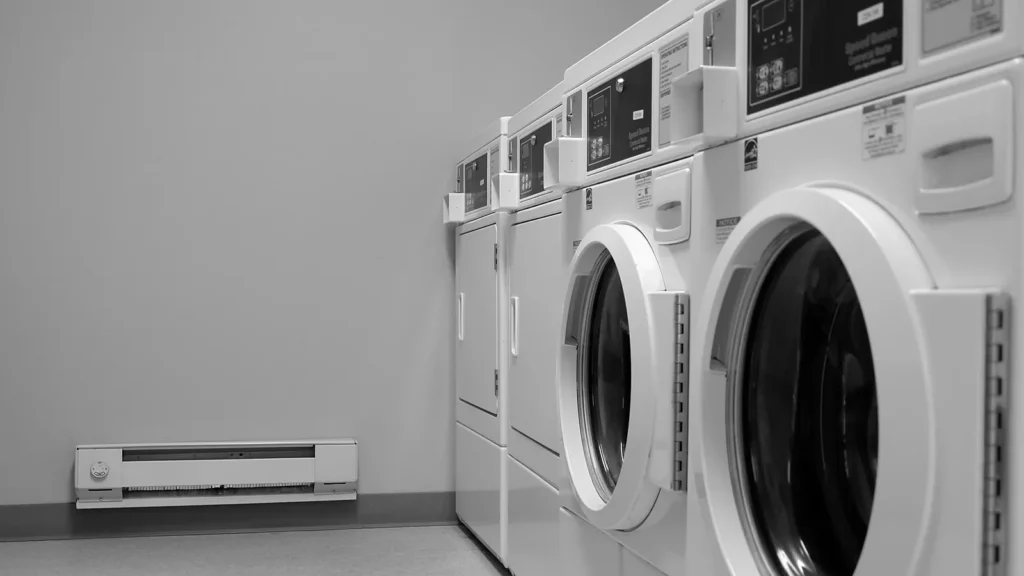
Short answer: When a Speed Queen washer won’t drain in a building laundry room, it usually has a clogged drain path (coins, socks, lint), a failed drain pump on top- or front-load models, a stuck drain valve on a washer-extractor, or a backed-up building drain. Staff can check for a backup; the machine itself needs a technician ($120 commercial diagnostic).
This guide is for property managers and building staff with coin- or card-operated Speed Queen washers in a shared laundry room: who to call first, why the machines stop draining, what staff can check, and how to keep the room running. Pros Fix Appliances is an independent repair company, not a Speed Queen distributor, and uses OEM parts whenever they’re available.
Who should you call first?
Check who owns the machines before calling anyone. Many apartment laundry rooms are run by a laundry route company that leases the room and owns and services the equipment; if that’s your setup, a washer that won’t drain is their call under the contract. If the property owns the washers, the repair is yours to arrange, and a laundry repair vendor is the next call.
Pump or drain valve: which machine do you have?
How a Speed Queen washer drains depends on the machine, and it changes the diagnosis. The top-load and front-load washers in most apartment laundry rooms are home-sized machines that pump water up into a standpipe. Larger washer-extractors, the big front-loaders found in on-premises laundries, typically drain by gravity through a drain valve into a trough or floor drain. The model and serial plate settles it; Alliance Laundry Systems, which makes Speed Queen, publishes literature by model on its document portal.
Why won’t a Speed Queen commercial washer drain?
A Speed Queen commercial washer that won’t drain usually has one of four problems, listed in the order we check them in a shared laundry room.
1. Something is blocking the drain path
Coins, hair ties, bra wires, small socks and lint from residents’ loads lodge in the pump inlet, the drain hose or the valve. Tell: the washer tries to drain, and you may hear the pump run, but the water drops slowly or not at all.
2. The building drain is backed up
If water comes back up out of the standpipe, floor drain or trough, or neighboring machines drain slowly too, the building’s drain line is the problem. That’s a plumber’s job; we handle the washer up to its drain connection.
3. The drain pump or drain valve has failed
On pump-drain machines, a seized or burned-out pump leaves the tub full; you’ll hear silence or a hum where the pump should run, often with a drain message on the display. On a gravity-drain washer-extractor, a valve that won’t open holds the water in, and the technician checks the valve, its control signal and the path below it.
4. A lock or control fault stopped the cycle
A front-load door stays locked while water is inside, so a drain fault often looks like a door that won’t open. A failed lock, water-level sensing or the control can also halt the cycle before the drain step; note the exact display message for the technician.
What on-site staff can check safely
| What staff see | Likely cause | First step | Who fixes it |
|---|---|---|---|
| Water backing up from the standpipe or floor drain | Building drain clog | Stop using machines on that drain | Plumber |
| One washer full of water, others fine | Object or lint in the pump, hose or valve | Turn it off and tag it out | Laundry technician |
| Washer full, silent, message on the display | Failed pump, valve, lock or control | Photograph the display and machine number | Laundry technician |
| Front-load door won’t open after a cycle | Water still inside, or a lock fault | Don’t force the door | Laundry technician |
| Water on the floor around the machine | Leak at the pump, hose or door seal | Shut off power before stepping in | Technician; plumber if it’s the drain |
- Tag it out with an out-of-order sign so residents don’t add another load or payment.
- Kill power if there’s water on the floor: switch off the machine’s breaker or disconnect before anyone steps in.
- Check the neighbors. If the next machine on the same drain backs up too, call a plumber.
- Look at the hose behind the machine with the power off; don’t move a bolted-down machine.
- Record the details: machine number, model and serial, the exact display message, where in the cycle it stopped, and a photo.
Leave the rest to a technician: staff shouldn’t open service panels, bail water with the power on, or force a locked door, because line voltage sits behind the panels.
Keeping laundry-room downtime short
Fast laundry-room repairs come from paperwork done in advance and a vendor who can dispatch the same day. For property accounts, Pros Fix Appliances provides:
- Paperwork: a certificate of insurance naming the property as additional insured, a W-9, our BHGS registration (A49955) and a technician list; see what a COI is and why your vendor needs one.
- Dispatch: same-day for work orders received before noon, next business day otherwise, and an after-hours line for active leaks.
- Billing: AppFolio, Yardi, RealPage, Buildium and Entrata vendor portals; Net-30 by unit, PO or work order on approved accounts; a monthly statement per property; photos of the fault and repair on every ticket.
Prevention helps too. Speed Queen’s maintenance tips call for checking hoses monthly and replacing them every five years, checking filter screens yearly and, on washer-extractors, testing the door lock daily; a sign asking residents to empty pockets keeps coins out of pumps. We also offer scheduled preventive maintenance, and our apartment turnover appliance checklist covers in-unit machines. When a quote passes half the cost of a comparable new machine, replace it.
When to call a laundry technician
Call once the machine is tagged out and the building drain is ruled out; an active leak is an emergency, and emergency calls are answered 24/7. Call (866) 696-7767, book online, or set up a vendor account through our contact page. The $120 commercial laundry diagnostic covers the trip, testing and a written quote, and it’s applied to the repair you approve. Fees are the same across Los Angeles County and Orange County, with no travel charge. More on the machines we service is on our washer repair page.
Frequently asked questions
How do you drain a Speed Queen commercial washer that’s full of water?
Building staff shouldn’t open the panels to drain it. Turn the machine off, tag it out and leave the water and clothes inside; a technician drains it through the pump, hose or drain valve, depending on the model, and finds out why it stopped. If water is on the floor, shut off power first.
Is a washer that won’t drain an emergency for a building?
Usually not: tag it out and book a same-day visit before noon. It becomes an emergency when water leaks onto the floor or backs up from a drain, where it can reach wiring or units below. Shut off power to the machine, stop using that drain and call; emergency calls are answered 24/7.
What does a commercial washer drain repair cost?
It starts with the $120 commercial laundry diagnostic, which is applied to the repair if you approve it. Commercial parts are model-specific, so the repair is quoted in writing before any work. Approved accounts can be billed Net-30 by unit, PO or work order, and there’s no travel charge anywhere in LA County or Orange County.