Short answer: A Wolf range igniter clicking nonstop usually means a wet or greasy electrode or spark switch after a spill or cleaning, a burner cap that isn’t seated flat, or a failing spark module. Dry the burners and reseat the caps first. If it persists, igniter or valve service on a Wolf or Viking range typically runs $320–$720 in Los Angeles.
For Wolf and Viking owners whose igniters click after a boil-over, after cleaning or with every knob off: what it means, what you can fix yourself, and what a repair costs in Los Angeles and Orange County.
Why does a Wolf range igniter keep clicking?
A Wolf range igniter keeps clicking when the range can’t tell that the burner is lit. Turning a knob closes a spark switch, and the spark module fires the igniters until it senses flame at the electrode; many models also relight a burner that blows out. Because the module senses flame through the electrode itself, water, grease, a crooked cap or a wiring fault keeps it clicking.
Here are the causes in the order we usually find them.
1. Water from a boil-over or a wipe-down
Pasta water or spray cleaner reaches an electrode or runs behind the knobs to the spark switches. Wolf’s troubleshooting list says to let the area dry completely. Tell: it started right after cooking or cleaning and often stops within a day.
2. A burner cap or head out of place
A crooked cap keeps the flame off the electrode, so the module never senses it. Wolf says the cap must sit flat; Viking says the burner head’s tabs must not line up with the igniter. Tell: one burner, right after cleaning.
3. Grease on the electrode or a cracked igniter
Baked-on grease weakens the spark, and a hairline crack in the igniter’s white ceramic lets the spark escape before it reaches the gas. Tell: one burner only, and drying doesn’t help.
4. A shorted spark switch
Liquid that runs down a knob’s valve stem can bridge the spark switch there, so the module thinks a burner is on. Wolf also says to push each knob in and check that it springs back. Tell: clicking with every knob off.
5. A grounding or polarity problem
Viking’s manual lists an ungrounded power supply and reversed polarity as causes of sparking that continues after the burner lights. Tell: every burner does it, often after a move or a new outlet.
6. A failing spark module
Tell: erratic clicking from all burners after everything has dried, or no spark at all with the power on.
7. Foil on the cooktop
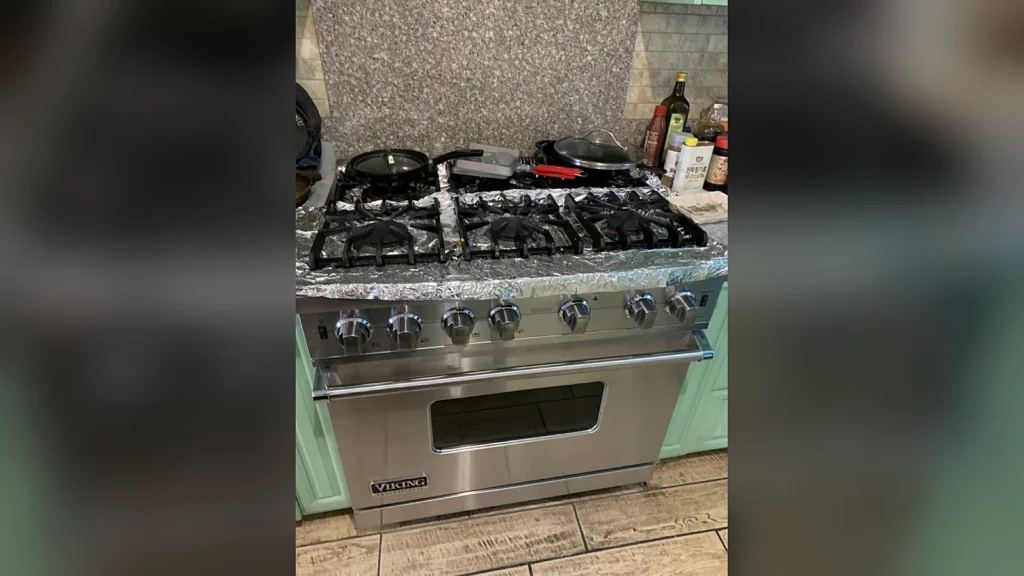
Foil around the burners traps spills against the igniters and, where it touches an electrode, gives the spark somewhere else to go. Wolf’s gas range use and care guide says not to line any part of the range with foil, and SoCalGas warns it can restrict venting and cause carbon monoxide. The Viking pictured here had foil around every burner.
Safe checks before you call
Most Wolf and Viking igniter clicking is fixed with a towel, a hair dryer and patience. Work with the knobs off and the burners cool.
- Smell for gas first. A brief whiff after a failed light clears within a minute. If the smell lingers, stop and follow the gas steps below; don’t touch the breaker or any switch.
- Stop the noise. If it clicks with every knob off, switch off the range’s breaker; the oven goes off with it.
- Take the burner apart. Lift off the grates, caps and heads and wipe the base with a damp cloth. Wolf says never to spray water or cleaner directly on an igniter.
- Dry and clean. Use a hair dryer for a few minutes or leave the parts off overnight. Brush the electrode tip with a dry toothbrush; don’t scrape or bend it. Viking’s 5 Series gas range manual says to clear clogged ports with a straight pin, not a toothpick.
- Reassemble. Caps flat and centered; on a Viking, the head’s tabs away from the igniter and the arrow toward the back.
- Test one burner at a time. Restore power. A healthy burner clicks, lights within a few seconds and goes quiet. If it clicks without lighting, turn it off and don’t keep retrying.
If you smell gas: leave the house, don’t switch lights or appliances on or off or use anything that could spark, and call SoCalGas at 1-800-427-2200 from outside, or 911 if anyone is in danger. Those steps are from SoCalGas’s own gas leak safety page.
Stop and call a technician if the clicking returns after a day of drying, a burner won’t light with its cap seated, or you can see a cracked igniter, scorched wiring or melted knob parts.
How much does Wolf or Viking igniter repair cost?
Drying and reseating a Wolf or Viking burner costs nothing. A failed igniter, spark switch or valve on a Wolf or Viking range typically costs $320–$720 to repair in Los Angeles and Orange County, parts and labor.
| Problem | Fix | Typical LA price |
|---|---|---|
| Wet, greasy or crooked burner parts | Dry, clean and reseat | No part needed |
| Cracked igniter or shorted spark switch (Wolf, Viking) | New igniter or switch | $320–$720 |
| Failed spark module (Wolf, Viking) | New module | Quoted in writing after testing |
| Igniter or spark module, other gas ranges and cooktops | New part | $160–$300 |
| Outlet not grounded or polarity reversed | An electrician corrects the outlet | Not a range repair |
The range diagnostic is $69 and is applied to the repair you approve. Fees are the same across LA County and Orange County with no travel charge, and the price is in writing before work starts. OEM Wolf and Viking parts sometimes have to be ordered, which means a second visit.
Is a clicking Wolf or Viking range worth repairing?
A clicking Wolf or Viking range is almost always worth repairing: professional ranges are built to be serviced, and an ignition repair is a small fraction of the price of a new range. The 50% rule: repair when the written quote is under half the price of a comparable new unit and the appliance has life left; ranges last roughly 15 years.
Check the warranty first. Wolf covers parts and labor for two years from installation, and Viking’s freestanding gas ranges carry a two-year full warranty, with repairs through each brand’s own service network. Pros Fix Appliances is independent, not factory-certified, so if your range is that new, call the manufacturer first.
When to call a technician
Call a technician when Wolf or Viking clicking survives a day of drying or a burner won’t light; for a gas smell that doesn’t clear, call SoCalGas first.
Pros Fix Appliances repairs Wolf and Viking ranges and rangetops across Los Angeles County and Orange County, including Wolf range repair in Sherman Oaks. Calls placed before noon are usually seen the same day; later calls are typically seen the next business day. Have the model and serial number from the rating plate ready so the technician brings the right parts. Call (866) 696-7767 or book online.
More help: stove and cooktop repair, oven and range repair, oven igniter glowing but not lighting, why a gas stove pilot light keeps going out for older ranges, and range hood fan not working if the hood above the range has quit.
Frequently asked questions
Is it dangerous if my gas stove keeps clicking?
The clicking itself isn’t dangerous. The risk is a burner that clicks without lighting while gas flows: turn it off, let the air clear and don’t keep retrying. If you smell gas that doesn’t fade, leave the house and call SoCalGas or 911 from outside.
Why does only one burner keep clicking?
A single burner points to that burner: a cap that isn’t sitting flat, food or moisture on its electrode, a cracked ceramic insulator, or the spark switch behind that knob. Reseat and dry it first. If it still clicks a day later, the igniter or switch needs replacing.
Can I light a Wolf or Viking burner with a lighter if it won’t spark?
In a power outage, Wolf’s guide says yes: turn the knob to Hi and light the burner with a long lighter. Viking’s 5 Series manual says not to use the range during a power failure. If the igniters fail with the power on, get the fault fixed rather than working around it.