Short answer: An apartment turnover appliance checklist runs every appliance and records the result: refrigerator at 40°F or below and freezer at 0°F, every burner and the oven temperature, a full dishwasher cycle, a washer fill and spin, dryer heat and vent, microwave and disposal. Photograph model plates and faults, then repair or replace by the 50% rule.
This checklist is for property managers and maintenance supervisors turning apartments in Los Angeles and Orange County: what to test, what a pass looks like, the order that saves time, the records to keep and when a repair isn’t worth it.
What should an apartment turnover appliance checklist include?
An apartment turnover appliance checklist should cover every appliance in the unit, tested while it runs, with the result written down. A walk-through misses faults that only show when an appliance runs, like a refrigerator that won’t hold temperature or a dishwasher that leaks mid-cycle.
| Appliance | What to test | A pass looks like | Common fixes, typical LA price |
|---|---|---|---|
| Refrigerator and freezer | Thermometer in each compartment, door gaskets, ice maker and dispenser, condenser coils | 40°F or below and 0°F; gaskets seal all the way round; ice drops, no drips | Fan motor $190–$340; defrost parts $190–$360; ice maker or water valve $210–$420 |
| Range, cooktop and oven | Every burner, oven preheat with an oven thermometer, door gasket, anti-tip bracket | Every burner lights or heats; oven reaches its setting; bracket engaged | Igniter $170–$320; element $180–$340; temperature sensor $160–$280 |
| Dishwasher | Full cycle after cleaning the filter; drips under the sink and at the door edge | Fills, washes and drains with no standing water or leaks | Drain pump $190–$330; door latch $160–$290; inlet valve $170–$300 |
| Washer | Hoses and valves; a short cycle; door boot on front-loaders | Fills hot and cold, drains, spins without walking; hoses free of bulges or cracks | Drain pump $190–$340; lid or door lock $160–$300; door boot $220–$420 |
| Dryer | Lint filter, duct and outside flap, a timed run on heat | Heats, tumbles quietly, flap opens; metal duct | Thermal fuse or thermostat $140–$240; heating element $180–$320 |
| Microwave | Heat a cup of water; door, turntable, vent fan and light | Water hot; door closes firmly and isn’t damaged | Door switch or fuse $140–$240; magnetron $260–$480 |
| Garbage disposal | Run with water; check the sink flange and drain | Grinds without humming or leaks | Jam clearing within the $69 diagnostic; flange reseal $140–$220 |
The temperature targets come from FoodSafety.gov’s cold storage chart. The NFPA’s dryer safety tips call for metal duct and name failure to clean dryers as the leading cause of home dryer fires, so check the duct, not just the lint filter.
Running the checklist in each unit
The fastest way to run an apartment turnover appliance check is to start the long cycles first.
- Start the dishwasher and a short washer cycle, and put thermometers in the refrigerator and freezer.
- Photograph each model and serial plate; our guide to finding appliance model numbers shows where they are.
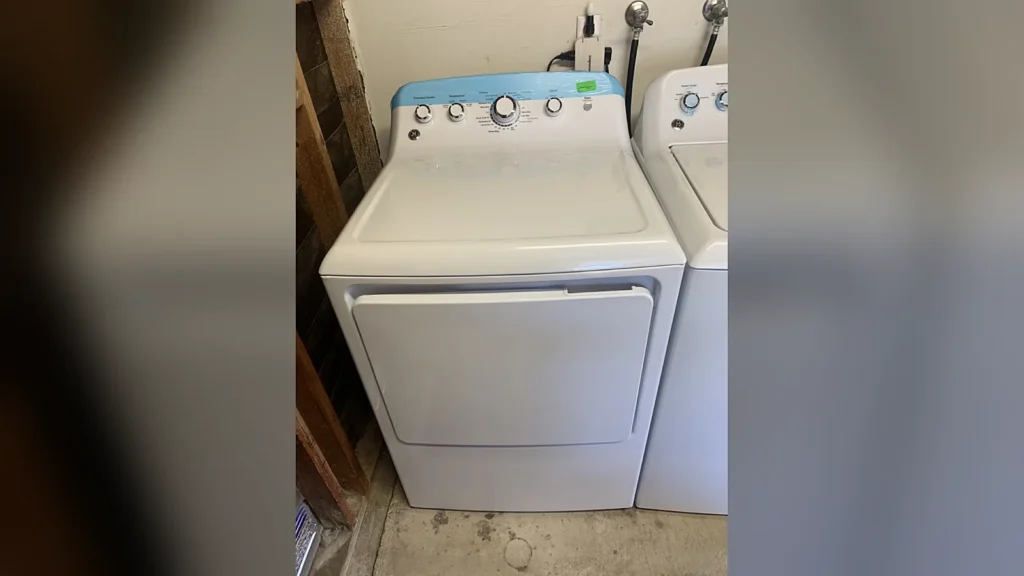
- Check gaskets, hoses and valves, like the pair on the wall behind the washer at the top of this page.
- Light or heat every burner, preheat the oven and confirm the anti-tip bracket.
- Run the dryer on heat and check the outside vent flap, then test the microwave and disposal.
- Read the thermometers last, check for drips, and record pass or fail with photos.
Stop points: don’t open appliance panels or a microwave cabinet during an inspection. Switch off the breaker if water reaches an outlet. If the unit smells of gas, leave, call SoCalGas at 1-800-427-2200 or 911 from outside, and keep the unit closed until the gas company clears it.
What records should you keep for each unit?
Keep one appliance record per unit, with model and serial numbers, ages, turnover readings and photos of every fault and repair. It answers these questions later:
- Warranty and recalls: claims and recall checks start with the model and serial number; the CPSC recall search lists affected models.
- Repair or replace: the age turns a repair quote into a clear decision.
- Condition questions: dated photos show what the appliance looked like at move-out and after the repair.
- Filters: note the date of each refrigerator water filter change.
Should you repair or replace appliances at turnover?
Repair an apartment appliance when the quote is under half the price of a comparable new unit and the appliance has life left: roughly 10–12 years for mainstream refrigerators, washers and dishwashers, and 15 for ranges and dryers. Replace it when either test fails.
A $650–$1,400 sealed-system repair on an 11-year-old refrigerator, or a $450–$750 tub bearing on an aging washer, usually fails the test; fans, pumps, igniters, latches and elements almost never do. Turnover is the easiest time to replace or upgrade, because the unit is empty; in senior living apartments, add the features in our guide to senior living kitchen appliance safety.
How Pros Fix Appliances handles turnover inspections
Pros Fix Appliances runs turnover inspections and repairs for apartment communities in Glendale and across Los Angeles and Orange County:
- Reports: PDF turnover inspection reports by unit, with photos of the fault and the repair on every ticket.
- Work orders: AppFolio, Yardi, RealPage, Buildium and Entrata vendor portals.
- Response: same-day dispatch for work orders received before noon, next business day otherwise, and an after-hours line for refrigeration failures and leaks.
- Billing: Net-30 by unit, purchase order or work order, with a monthly statement per property.
- Vendor file: a certificate of insurance naming your company as additional insured, a W-9, our BHGS registration (A49955) and a technician list for building access. Our explainer on what a vendor COI should include covers the details.
When to call a technician
Call a technician for any appliance that fails the checklist, and right away for leaks, a burning smell or a breaker that trips again.
Work orders placed before noon are usually seen the same day across Los Angeles County and Orange County; later ones are typically seen the next business day. The diagnostic is $69 for most in-unit appliances and $85 for refrigerators and freezers, applied to the repair, with the same fees in both counties and no travel charge. Call (866) 696-7767, book online or use our contact page to set up a vendor account. Our washer repair page lists typical washer prices.
Frequently asked questions
How long does an appliance turnover inspection take?
It depends on the number of appliances and the length of the dishwasher’s cycle. Starting the dishwasher and washer first and testing everything else while they run keeps the inspection close to the longest cycle. Turn on a refrigerator that sat switched off a day ahead.
What temperature should an apartment refrigerator be at turnover?
40°F or below in the fresh-food section and 0°F or below in the freezer, the FoodSafety.gov targets. Check with an appliance thermometer once the refrigerator has run for several hours. A refrigerator that can’t reach those numbers needs a diagnosis before the next resident moves in.
Can a repair vendor send turnover reports through our property management portal?
Pros Fix Appliances works with property managers through AppFolio, Yardi, RealPage, Buildium and Entrata. Every ticket includes photos of the fault and the repair, turnover inspections come as PDF reports by unit, and approved accounts are billed Net-30 by unit, purchase order or work order.