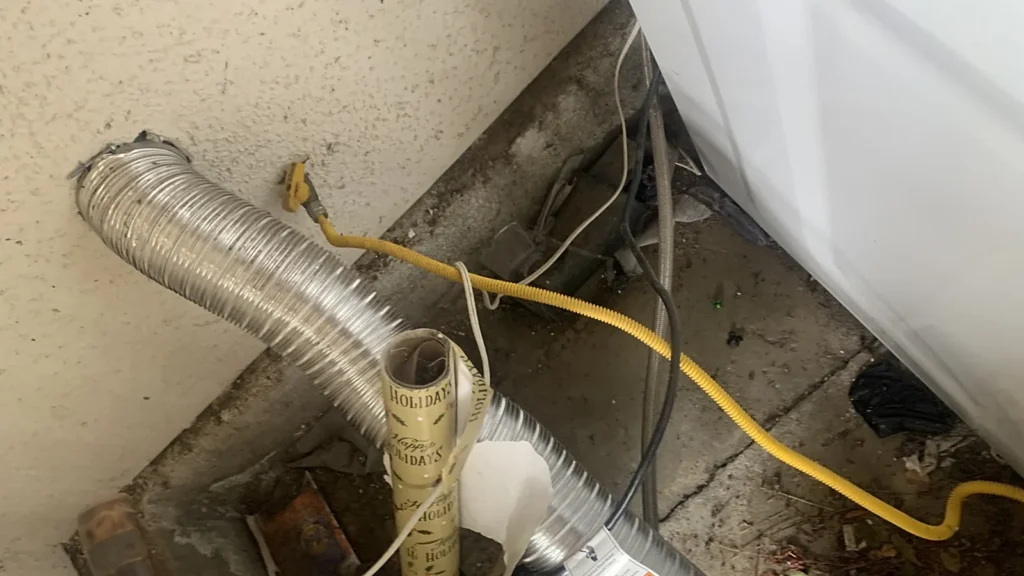
Short answer: Dryer vent cleaning cost in Los Angeles depends on the run: its length, number of elbows, a wall or roof exit, and condo or high-rise access, so get a written price for the whole run. NFPA says to clean the vent once a year. Skipping it costs more: a restricted vent can blow the dryer’s thermal fuse ($140–$240 to replace).
This guide is for Los Angeles and Orange County homeowners, renters and property managers whose dryer takes longer than it used to, or who can’t remember the last vent cleaning. It covers what moves the price, the warning signs, what you can safely do yourself, and when the problem is the dryer rather than the duct.
How much does dryer vent cleaning cost in Los Angeles?
Dryer vent cleaning cost in Los Angeles has no single price, because no two vent runs are the same. A short, straight run through the wall behind a ground-floor laundry room is a quick job; a long run with several elbows that exits on a second-story roof, or a condo dryer tied into a building exhaust, takes more time, more equipment and sometimes roof access. Ask for a written price that covers the whole run, from the back of the dryer to the outside hood.
| What affects the price | Why it matters | What to ask |
|---|---|---|
| Length of the run | Longer ducts hold more lint and take longer to brush | How far is the dryer from the outside hood? |
| Number of elbows | Every bend traps lint and slows the brush | How many turns does the duct make? |
| Where it exits | Roof exits need ladder or roof access | Is the hood on a wall or the roof? |
| Building type | Condos and apartments may have shared exhausts, HOA rules or a building contractor | Who maintains the duct inside the walls? |
| Duct condition | Crushed, plastic or coiled-foil duct should be replaced, not cleaned | Is duct replacement included? |
| Blockages | Packed lint or a bird nest at the hood takes extra time | Does the price include clearing the hood and checking the flap? |
Pros Fix Appliances repairs dryers and doesn’t publish a vent-cleaning price list. On a dryer repair visit ($69 diagnostic, applied to the repair), the technician checks airflow at the dryer and the transition duct behind it, because a restricted vent is a common reason dryers overheat and fail. Full runs through walls and roofs are usually work for a dedicated dryer-vent cleaning company.
What are the signs of a clogged dryer vent?
The first sign of a clogged dryer vent is time. The U.S. Fire Administration (USFA) says that if heavy items such as jeans or towels take a long time to dry, or clothes feel hotter than usual at the end of the cycle, a clogged vent is the likely problem. Other signs:
- Loads need a second cycle, or the dryer’s top and the laundry room get unusually hot.
- A hot or burning-lint smell while the dryer runs. Stop using it.
- Lint around the outside hood, or a hood flap that doesn’t open when the dryer runs.
- A dryer that stops heating or shuts off mid-cycle, often because a thermal fuse or high-limit thermostat tripped from overheating.
- On some newer dryers, a vent or airflow warning on the display; your manual lists the code.
How often should a dryer vent be cleaned?
A dryer vent should be cleaned at least once a year, or sooner if drying times creep up. That’s the advice in the National Fire Protection Association’s clothes dryer safety tip sheet: once a year, or more often if clothes take longer than normal to dry, clean the lint out of the vent pipe or have a lint removal service do it.
- Clean the lint screen before or after every load. The USFA also suggests scrubbing it with a nylon brush at least every six months.
- Check the outside hood a few times a year. The flap should swing freely, and the USFA advises against wire screen or cloth over the outlet, because both catch lint.
- Clean more often for long runs, roof exits, big households, and dryers in closets or upstairs laundry rooms, which often need longer ducts.
Can a clogged dryer vent cause a fire?
Yes. Failure to clean is the leading cause of home clothes dryer fires, according to the National Fire Protection Association (NFPA); lint is highly combustible, the USFA notes, and a restricted vent traps heat in the dryer and duct. NFPA’s 2020 report on home dryer fires estimates that U.S. fire departments responded to an average of 13,820 home fires a year involving dryers in 2014–2018, with an average of 7 civilian deaths and 344 injuries a year; failure to clean caused about a third of them (32%), which NFPA says appears to be mainly lint build-up.
Newer federal data points the same way: the U.S. Fire Administration reports that failure to clean (31%) was the leading factor in the ignition of home clothes dryer fires from 2018 to 2020. Duct material matters too. The USFA recommends replacing plastic or coiled-foil venting with rigid, non-ribbed metal duct, and SoCalGas says plastic and vinyl duct isn’t approved for natural gas dryers.
What you can safely clean yourself
Most homeowners can clean the lint screen, the dryer’s outlet, a short transition duct and the outside hood. Unplug an electric dryer first, since it runs on 240 volts, and treat a gas dryer’s connector gently.
- Unplug the dryer. On a gas dryer, also close the gas shutoff valve behind it, and don’t kink or strain the flexible gas connector as you move it.
- Slide the dryer out and loosen the clamp that holds the transition duct to the dryer outlet.
- Vacuum the lint from the dryer outlet, the lint-screen slot and the transition duct.
- Brush the wall duct as far as a dryer-vent brush kit reaches; that works for short, straight runs.
- Clear the outside hood of lint and nests, and make sure the flap swings freely.
- Reconnect with metal duct, keep the transition short and uncrushed, push the dryer back without flattening it, and run a timed load while you check the airflow at the hood.
Stop if you smell gas: leave the house without touching light switches and call SoCalGas or 911 from outside. Leave roof exits, concealed runs and shared building exhausts to a professional.
Vent or dryer: what to fix after cleaning
Clean the vent first, then judge the dryer. If drying is still slow with a clear vent, or the dryer won’t heat at all, the dryer needs a repair, and a restricted vent may be what caused it. Typical Los Angeles prices for mainstream dryers, parts and labor included:
| Symptom with a clear vent | Likely cause | Typical price |
|---|---|---|
| No heat at all (electric) | Blown thermal fuse or failed thermostat | $140–$240 |
| Weak heat, long dry times (electric) | Failing heating element | $180–$320 |
| No heat (gas) | Igniter or gas valve coils | $170–$320 |
| Thumping, squealing or a drum that won’t turn | Belt, rollers or idler pulley | $190–$340 |
| Hums but won’t start, or stops when hot | Drive motor | $280–$480 |
| Error codes or erratic cycles | Control board | $260–$520 |
The dryer diagnostic is $69 and is applied to the repair you approve. If a dryer near the end of its roughly 15-year life needs a motor or board, compare the quote with half the price of a comparable new dryer first. Our guides to a dryer that takes too long to dry and a dryer that isn’t heating go deeper.
Who to call: a vent cleaner or an appliance technician
Stop using the dryer and unplug it if you smell burning, see scorch marks or the cabinet is too hot to touch, and don’t run any dryer while you’re out or asleep, as NFPA advises. Call a dryer-vent cleaning company for long or concealed runs, roof exits and crushed duct inside walls; in apartments and condos, ask management first. Call an appliance technician when the dryer still underperforms with a clean vent, won’t heat or keeps blowing fuses. Stacked units in closets often need both; see our guide to stacked washer-dryer repair.
For dryer repairs, calls placed before noon are usually seen the same day across Los Angeles County and Orange County; later calls are typically next business day. The $69 diagnostic is the same everywhere we work, with no travel charge. Call (866) 696-7767, book online or see our dryer repair page.
Frequently asked questions
Is flexible foil dryer duct safe?
Not for the main run. The U.S. Fire Administration says even flexible foil vents are a poor choice because they can twist and let lint build up, and it recommends rigid, non-ribbed metal duct. A short, listed transition duct between the dryer and the wall is common; plastic or vinyl duct should be replaced.
Why does my dryer keep blowing the thermal fuse?
A thermal fuse is a one-time safety cutoff that opens when the dryer overheats, so a new one will blow again unless the cause is fixed. A restricted or crushed vent is the usual culprit; a failed cycling thermostat or a shorted heating element can also do it. Replacing the fuse or thermostat runs $140–$240.
Does a condo or apartment dryer vent need cleaning too?
Yes, often more than a house vent, because dryers in closets and upstairs laundry rooms usually need longer ducts, and the USFA notes that long runs with many bends collect lint faster. In some buildings the HOA or management maintains the dryer exhaust, so ask before hiring anyone for the duct inside the walls.