Short answer: A low, steady hum is normal compressor and fan noise. When a refrigerator starts humming loudly, the usual causes are a worn condenser or evaporator fan motor, an ice-maker water valve with no water, or a compressor straining to start. Check leveling and the ice maker first; fan and valve repairs typically cost $190–$420 in Los Angeles.
This guide is for anyone whose refrigerator has gone from background noise to a hum you notice across the room. It explains which hums are normal, how to find the source in five minutes, what you can safely fix, and what each repair costs in Los Angeles County and Orange County.
Is it normal for a refrigerator to hum?
Yes. Whirlpool’s guide to normal refrigerator sounds says a low, steady hum from the compressor and fans is common, especially after the doors have been opened. These are normal too:
- A longer or higher-pitched hum from newer high-efficiency and variable-speed compressors, which run longer at lower power. Whirlpool says this is more noticeable in a warm room, after loading a lot of food, or when the doors open often.
- A brief buzz from the back as the ice maker fills. Samsung notes it’s louder when household water pressure is high.
- A whoosh of air from the fans, and a few seconds of rattle as the compressor shuts off.
A hum is worth investigating when it’s new, much louder than before, comes with grinding or squealing, or the food is getting warmer. Samsung’s noise guide draws the same line: if the hum is very loud, request service.
What makes a refrigerator hum loudly?
A handful of parts cause most loud hums. Where the sound comes from, and what changes it, points to the part.
| Where and when | Likely cause | What to do | Typical LA price |
|---|---|---|---|
| Inside the freezer; stops when you open the freezer door | Evaporator fan motor worn, or its blade hitting ice | Replace the fan; fix the defrost fault if there’s ice | $190–$340 fan; $190–$360 defrost |
| Bottom-back, loud hum or grind while it runs | Condenser fan motor bearings, or debris in the blade | Unplug, vacuum; replace a worn motor | $190–$340 |
| Back of the cabinet, hum or buzz with no ice or water | Water inlet valve: ice maker on with no water, a closed supply valve or a failing valve | Turn the ice maker off or restore water; replace the valve | $210–$420 |
| Bottom-back, hum for a few seconds then a click, repeating | Compressor not starting: start relay or overload | Book a repair | $160–$280 |
| Bottom-back, loud constant hum with the food warming | Compressor failing | Book a diagnosis | $650–$1,400 |
| Hum with a rattle or vibration | Cabinet not level, touching a wall or cabinet, loose drain pan, items on top | Level it; give it clearance | Free |
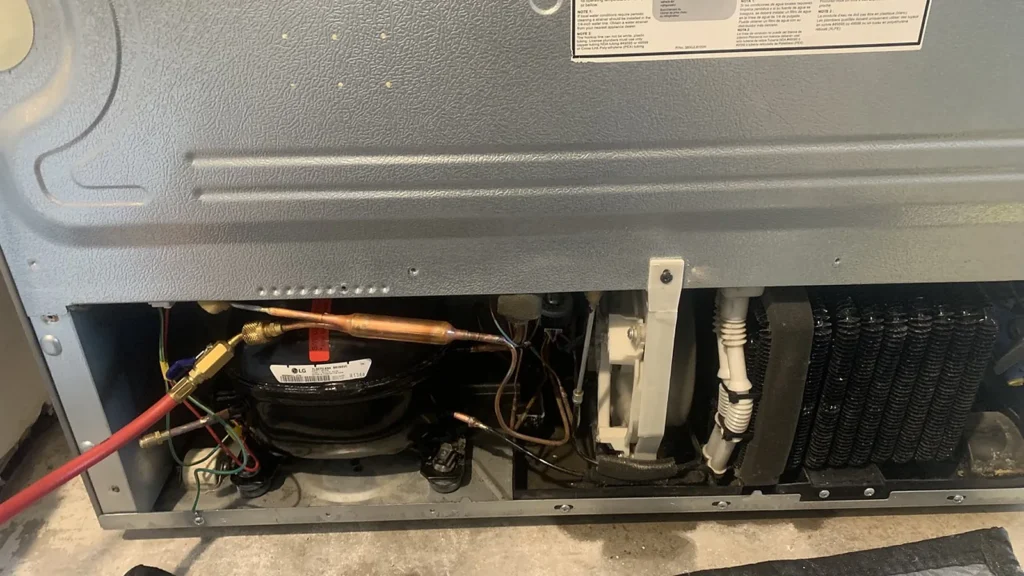
A condenser fan cools the compressor and the condenser coil in the bottom-back compartment; an evaporator fan sits behind the freezer’s back panel and moves cold air through both sections. On many built-ins, such as Sub-Zero’s classic built-in models, the compressor and condenser sit at the top behind the grille, so the same hums come from above.
The ice maker valve is the easiest to miss. Whirlpool explains that when the ice maker is on but not connected to water, the valve keeps opening and closing and hums or pulses; turn the ice maker off until a water line is connected.
How do you find where the hum is coming from?
Three quick tests, done in this order, identify the source in most kitchens:
- Open the freezer door. On many models the evaporator fan stops when the door opens. If the hum drops away, it’s that fan, and ticking or scraping means ice on the blade.
- Turn the ice maker off. If the hum stops within a few minutes and doesn’t return, it was the water valve. Check the supply valve and the filter date.
- Listen at the bottom-back grille. A hum that grinds or rises and falls is the condenser fan; a hum that ends in a click every few minutes is the compressor failing to start, covered in our guide to a refrigerator clicking.
Then check the temperature: 40°F or below in the fridge and 0°F in the freezer. A loud hum with normal temperatures can wait for an appointment; a loud hum with warming food can’t.
Safe to do yourself: unplug the refrigerator, then vacuum the condenser coil and the fan area behind the bottom grille, removing anything the blade could catch. Stop and call before removing the rear access panel or the freezer’s back panel: the condenser fan can start without warning when power is on and the compressor terminals carry line voltage. Unplug at once if you smell burning.
Can a refrigerator hum because it isn’t level?
Yes. A cabinet that rocks or touches a wall turns normal compressor vibration into a loud hum or buzz. Whirlpool’s first fix for a vibrating refrigerator is to adjust the leveling legs, and Samsung suggests moving it out about an inch so nothing behind it can rattle.
- Check that all four corners touch the floor and the cabinet doesn’t rock.
- Leave a little space at the back and sides, away from walls, cabinets and pipes.
- Take bottles and baskets off the top of the cabinet.
- Make sure the drain pan under the cabinet is seated.
Garage refrigerators in the Valley and inland Orange County often hum loudest in summer: heat makes the compressor and condenser fan run longer and harder, and dust collects faster on the coil.
What does it cost to fix a humming refrigerator, and when should you call?
Most loud-hum repairs cost $160–$420 in Los Angeles County and Orange County, parts and labor included.
| Repair | Typical LA/OC price |
|---|---|
| Evaporator or condenser fan motor | $190–$340 |
| Water inlet valve or ice-maker assembly | $210–$420 |
| Start relay or capacitor | $160–$280 |
| Defrost heater, thermostat or sensor (ice on the fan) | $190–$360 |
| Built-in condenser cleaning and fan motor (Sub-Zero, Thermador, Miele) | $220–$420 |
| Compressor or sealed system | $650–$1,400 |
The $85 refrigerator diagnostic covers the trip, testing and a written quote, and it’s applied to the repair if you approve it. Fees are the same in both counties, with no travel charge. Fans and valves are almost always worth fixing. A failing compressor on a mainstream refrigerator past 10–12 years usually isn’t: repair only when the quote is under half the price of a comparable new unit and the refrigerator has life left.
Call when the hum comes with grinding, squealing or warming food, or keeps going after the leveling and ice-maker checks. Calls placed before noon are usually seen the same day; later calls are typically seen the next business day. Call Pros Fix Appliances at (866) 696-7767 or book online. More about our refrigerator repair service, and for built-ins, our guide to Sub-Zero condenser cleaning.
Frequently asked questions
Why is my new refrigerator so loud?
New refrigerators use high-efficiency compressors that run longer and can make a higher-pitched or pulsing hum, which Whirlpool and GE describe as normal. Popping as the liner settles fades with time. Check that it’s level and that the ice maker is off if no water line is connected yet.
Is a loud humming refrigerator about to die?
Usually not. Fan motors and water valves get noisy before they fail, and both are one-visit repairs in the $190–$420 range in Los Angeles. A loud hum with warming food, or a hum that ends in a click every few minutes, is more serious and worth a call the same day.
Why does my refrigerator hum when the ice maker fills?
The water inlet valve buzzes briefly each time it opens to refill the ice maker, and Samsung notes the sound is louder when water pressure is high. A hum that lasts long after filling, or happens with no ice being made, usually means the valve isn’t getting water or is failing.