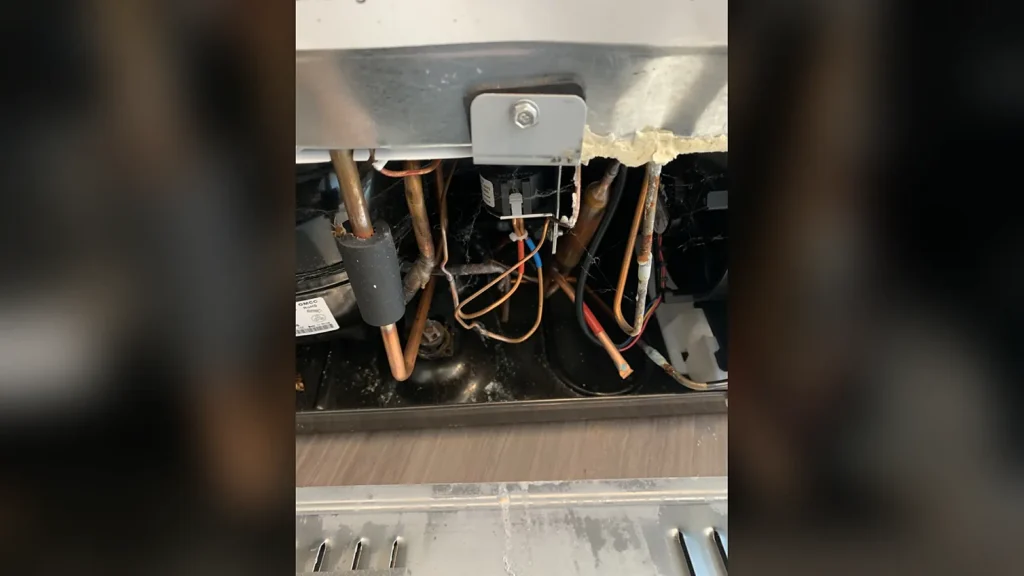
Short answer: A single click when the compressor starts or stops, or when the ice maker fills, is normal. Refrigerator clicking that repeats every few minutes from the bottom-back while the food gets warmer means the compressor isn’t starting, usually because the start relay has failed: a $160–$280 repair in Los Angeles. A failed compressor costs $650–$1,400.
This guide is for anyone hearing their refrigerator click and wondering whether to worry. It explains which clicks are normal, what repeated clicking with poor cooling means, what you can safely check, and what each repair costs in Los Angeles County and Orange County.
Is it normal for a refrigerator to click?
Usually, yes. Whirlpool’s guide to normal refrigerator sounds says relays and control boards click as they switch parts on and off, and a single click is common when the compressor starts or stops. These clicks are normal:
- One click as the compressor turns on or off.
- Soft clicks from the control board as fans, heaters and the air damper switch.
- A click a few times a day as a defrost starts or ends, often followed by sizzling as melt water hits the heater.
- Clicks and a whir from the ice maker during a harvest, then ice dropping into the bin.
- Pops and ticks as the plastic liner expands and contracts during a defrost or the first cool-down.
- A few clicks over several minutes after a power outage, while the compressor waits to restart.
What isn’t normal is clicking on a schedule, every few minutes all day, while the food gets warmer.
How do you tell which click you’re hearing?
Where the sound comes from and what the refrigerator is doing at the time narrow it down quickly.
| What you hear | Likely cause | What to do | Typical LA price |
|---|---|---|---|
| One click from the bottom-back as the hum starts or stops | Compressor cycling normally | Nothing | None |
| A click every few minutes from the bottom-back, a short hum or none, food warming | Failed start relay or overload; less often the compressor | Keep the doors closed; book a repair | $160–$280 relay; $650–$1,400 compressor |
| Clicking or buzzing from the back, no ice or water | Inlet valve with no water: ice maker on without a line, supply valve shut or fill tube frozen | Turn the ice maker off or restore the water | $210–$420 if the valve or ice maker has failed |
| Rapid ticking inside the freezer | Evaporator fan blade hitting ice after a defrost failure | Book a defrost repair | $190–$360 |
| Ticking or rattling from the bottom-back while it runs | Condenser fan striking debris, or a worn fan motor | Unplug and vacuum the grille area; call if it continues | $190–$340 for a fan motor |
| A click, then hours of silence while the fridge warms | Defrost timer or control stuck in defrost | Book a repair | Quoted at diagnosis; control board $280–$620 |
Why is my refrigerator clicking and not cooling?
Because the compressor is trying to start and can’t. Each attempt ends when the overload protector clicks off to protect the motor; a few minutes later it cools, resets and clicks again.
A conventional compressor has two small parts on its side, under a plastic cover. The start relay gives the motor a boost of current to get it turning. The overload protector is a heat-sensitive switch that cuts power when the motor draws too much. When either fails, or the compressor won’t turn, you get the click-pause-click cycle while the lights and display keep working. In the order we usually find them:
- Failed start relay: the most common cause and the least expensive fix.
- Failed overload protector: often replaced together with the relay.
- Weak power: an extension cord, power strip or loose outlet can starve the compressor at start-up.
- Overheating: a dust-packed condenser coil or a dead condenser fan lets the compressor overheat and trip the overload. Garage refrigerators in the Valley and inland Orange County see this most in summer.
- A failing compressor: if it won’t start with a good relay and proper voltage, it’s sealed-system work.
Refrigerators with inverter compressors, including many newer LG and Samsung models, have no plug-on start relay; an electronic inverter board starts the compressor, so the same symptom points to that board or the compressor.
Can the ice maker or water valve make clicking sounds?
Yes. The water inlet valve, an electric valve at the back of the cabinet that opens to fill the ice maker and dispenser, clicks or buzzes as it opens. With the ice maker switched on and no water connected, it keeps trying. Samsung and Whirlpool both say to turn the ice maker off when no water line is connected, to stop the noise and avoid damage.
The same clicking with a water line attached means the water isn’t arriving: a closed supply valve, a kinked line, an overdue filter or a frozen fill tube. Open the valve and change the filter if it’s due.
What can you safely check yourself?
Five minutes of listening usually separates a normal click from a failing part. Nothing here needs tools or opening a cover.
- Find the sound. Listen at the bottom-back grille, inside the freezer and at the ice maker, and time the clicks. A few seconds of hum ending in a click is the failed-start pattern.
- Check the temperature. A thermometer on the middle shelf should read 40°F or below in the fridge and 0°F in the freezer, the FDA’s limits.
- Plug it straight into the wall, not into an extension cord or power strip.
- Turn the ice maker off if no water line is connected.
- Unplug it and vacuum the condenser coil behind the bottom grille or on the back, and clear anything the fan could hit.
Stop and call if you smell burning, see scorch marks or the breaker trips more than once: unplug the refrigerator and leave it off. Don’t remove the compressor’s terminal cover or the relay; both carry line voltage.
Related guides: a refrigerator humming loudly, frost building up in the freezer (ticking from ice on the fan) and chest freezer clicking but not running.
What does it cost to fix, and when should you call?
Most clicking repairs cost $160–$420 in Los Angeles County and Orange County, parts and labor included; a failed compressor is the exception.
| Repair | Typical LA/OC price |
|---|---|
| Start relay or capacitor | $160–$280 |
| Evaporator or condenser fan motor | $190–$340 |
| Defrost heater, thermostat or sensor | $190–$360 |
| Water inlet valve or ice-maker assembly | $210–$420 |
| Main control board | $280–$620 |
| Compressor or sealed system | $650–$1,400 |
The $85 refrigerator diagnostic covers the trip, testing and a written quote, and it’s applied to the repair if you approve it. Fees are the same in both counties, with no travel charge. A relay is almost always worth replacing. A compressor on a mainstream refrigerator past 10–12 years usually isn’t: repair only when the quote is under half the price of a comparable new unit and the refrigerator has life left. Built-ins such as Sub-Zero, designed for 18–20 years, usually are worth it.
Call when the clicking repeats every few minutes, the fridge is above 40°F, or you smell burning. Keep the doors closed; FoodSafety.gov says a closed refrigerator keeps food safe for up to 4 hours without power. Calls placed before noon are usually seen the same day; later calls are typically seen the next business day. Call Pros Fix Appliances at (866) 696-7767 or book online. More about our refrigerator repair service.
Frequently asked questions
Can I replace a refrigerator start relay myself?
On many conventional compressors it’s possible, but test first. The relay plugs onto terminals that carry line voltage, the right part depends on the model number, and if the compressor itself has failed a new relay won’t start it. A technician measures the windings and current draw so you don’t pay for the wrong part.
Why is my new refrigerator clicking?
Electronic controls click as relays switch fans, heaters and dampers, and the liner pops while a new refrigerator settles to temperature. The most common fixable cause in a new install is an ice maker switched on before the water line is connected; turn it off until the line is in.
Does a clicking refrigerator mean the compressor is bad?
Usually not. A failed start relay or overload causes the same click-every-few-minutes pattern and costs $160–$280 to fix in Los Angeles. The compressor is the problem only when it still won’t start with a good relay and proper voltage; that repair runs $650–$1,400, so get it confirmed in writing first.