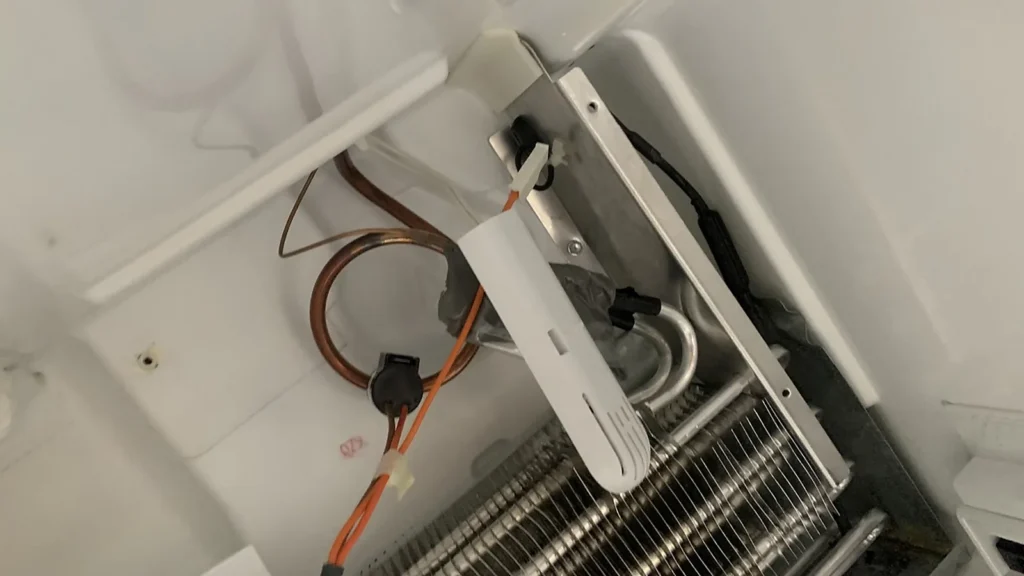
Short answer: If your refrigerator is not cooling but the freezer works, cold air isn’t reaching the fresh-food side. The usual causes, in the order we find them: frost buried the evaporator after a defrost failure, a dead evaporator fan, or a stuck damper. Most are one-visit repairs, typically $190–$360 in Los Angeles after an $85 diagnostic.
This is for anyone with a warm fridge and a cold freezer in a top-freezer, side-by-side or French-door refrigerator. It covers how the cold air travels, the six causes in order, safe checks, Los Angeles prices and when to call.
How the freezer cools the whole refrigerator
Most refrigerators make all their cold air at one coil, the evaporator, behind the freezer’s back panel. An evaporator fan blows air across it, and part of that air flows through a duct and a damper (a small air door) into the fresh-food section. A thermistor, an electronic temperature sensor, tells the control board when the fridge needs air.
So a cold freezer with a warm fridge means the cooling works but the delivery doesn’t. Refrigerators with two separate cooling systems are the exception: Sub-Zero’s dual-refrigeration built-ins, for example, or Viking 7 Series built-ins, which use two compressors so each compartment runs on its own. On those, a warm fridge can also be a fault in that side’s sealed system.
Why is my refrigerator not cooling but the freezer works?
A refrigerator that isn’t cooling while the freezer works almost always has an airflow problem: cold air from the freezer isn’t reaching the fresh-food section. These are the six causes in the order we find them on calls across Los Angeles County and Orange County.
1. Frost has buried the evaporator coil
A few times a day a defrost heater melts the frost off the coil and a defrost thermostat or sensor ends the cycle. When one of those parts or the control that times the cycle fails, frost builds until air can’t pass. Tells: frost or ice across the freezer’s back panel, a muffled or scraping fan, and a problem that crept in over days. Manufacturers see the same pattern; LG’s error-code list says its freezer-fan code can be caused by frost. Our guide to frost building up in the freezer goes deeper.
2. The evaporator fan motor has failed
With the fan dead, nothing pushes cold air to the fridge, which warms over a day or so. Tell: silence behind the freezer panel while the compressor runs. A squeal or ticking before it went quiet points the same way.
3. The damper is stuck closed
Ice, a broken gear or a failed damper motor can leave the air door shut. Tell: the fan runs, there’s no frost, the freezer is normal, and the fridge still won’t cool.
4. A thermistor is reading wrong
If the fresh-food sensor tells the board the fridge is already cold, the board never sends air. The technician checks its resistance against the chart for your model.
5. The control board isn’t powering the fan or damper
Less common. We test the part first, then the board’s output to it, so nobody pays for a board that wasn’t the problem.
6. A blocked vent or a leaking gasket
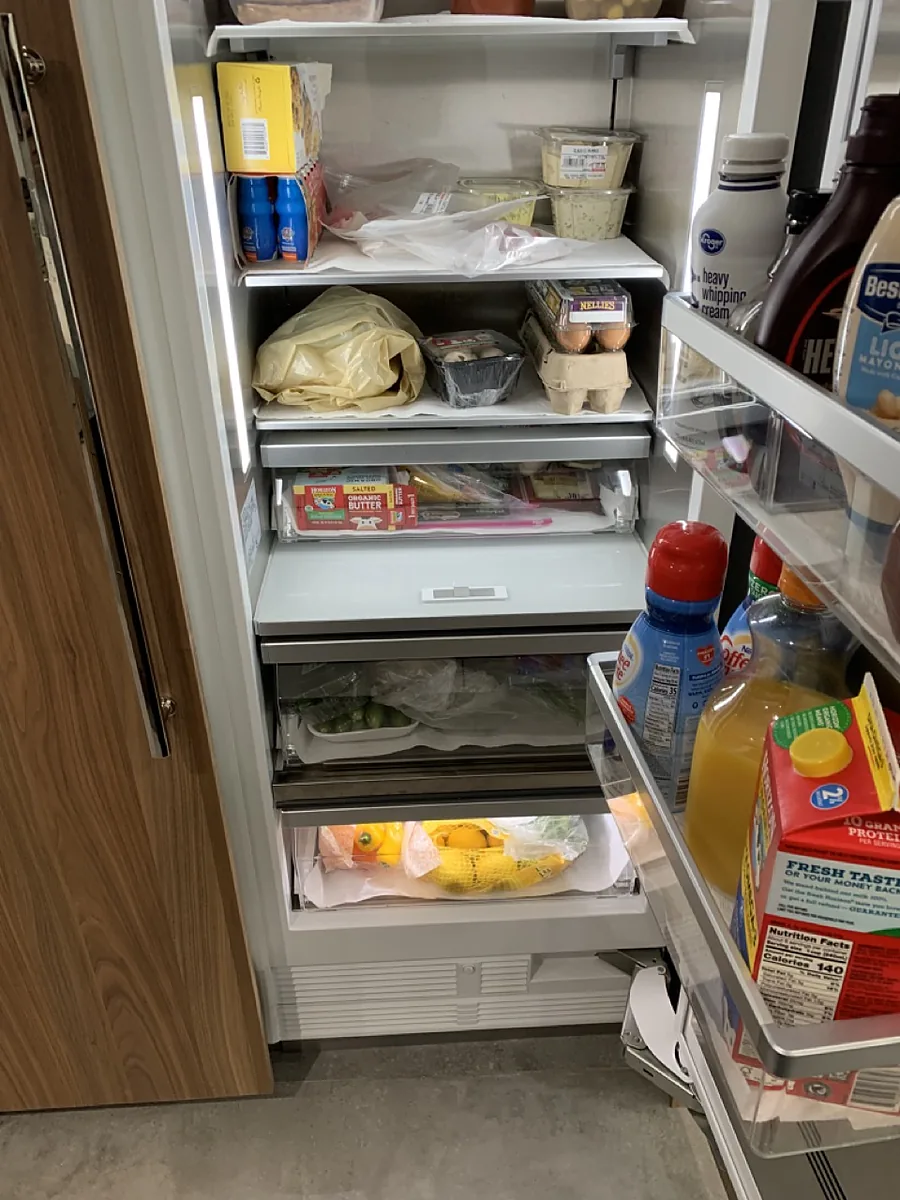
Sometimes the fix is free: a container against the air outlet or a torn door gasket. A packed fridge like the one below cools fine as long as the vents stay clear and the doors seal.
Safe checks you can do yourself
A homeowner can rule out the free causes of a warm fridge without tools or removing any panels:
- Measure. Leave an appliance thermometer in the middle of the fridge for a few hours. The FDA recommends 40°F or below in the refrigerator and 0°F in the freezer.
- Check the setting wasn’t bumped warmer. After any change, wait 24 hours before judging.
- Clear the vents, usually at the top rear of the fresh-food section.
- Listen for the fan. With the compressor running, open the freezer and press the door switch so the light goes off. On many models the fan stops when the door opens and restarts when the switch is pressed; keep your fingers clear.
- Look at the freezer’s back wall. Even frost or ice across it means the defrost system failed. Don’t chip at it: a punctured coil turns a defrost repair into sealed-system work ($650–$1,400).
- Test the door seal with a dollar bill at several points; see our door seal test and replacement guide.
Where to stop: don’t remove the freezer’s back panel (sharp fins, heater and wiring sit behind it), unplug the unit before touching anything beyond shelves and vents, and keep it unplugged if melting ice drips near the outlet or controls.
How much does the repair cost in Los Angeles?
Most repairs for a warm fridge with a cold freezer cost $190–$360 in Los Angeles, parts and labor; a control board runs $280–$620. Match what you see to the table; prices are typical LA County and Orange County ranges for mainstream brands, and the exact price is written before work starts.
| Cause | Signs | Fix | Typical LA price |
|---|---|---|---|
| Defrost failure | Frost on the freezer’s back panel; came on gradually | Replace heater, thermostat or sensor; clear the coil | $190–$360 |
| Evaporator fan motor | No fan sound; squeal beforehand | Replace the motor | $190–$340 |
| Stuck damper | Fan runs, no frost, fridge warm | Free or replace the damper | Quoted at diagnosis |
| Faulty thermistor | Warm at a normal setting; sometimes a sensor code | Replace the sensor | $190–$360 |
| Control board | Parts test good but get no power | Replace the board | $280–$620 |
| Blocked vent or worn gasket | Food against the outlet; seal fails the bill test | Rearrange; replace the gasket | Free / quoted by model |
| Dual-system built-in, fresh-food loop | Fresh-food side warm on a two-system built-in | Sealed-system repair, one loop | $900–$1,900 |
The refrigerator diagnostic is $85 (trip, testing and a written quote), applied to the repair you approve; decline and it’s all you pay. Same fees across both counties, no travel charge. These repairs nearly always pass the 50% rule (repair when the quote is under half the price of a comparable new unit and it has life left); our repair-or-replace guide covers the exceptions.
When to call a technician
Call a technician when the fresh-food section stays above 40°F after you’ve cleared the vents and checked the seal, or right away if you see frost on the freezer’s back wall or hear no fan. Move perishables to the freezer or a cooler with ice; FoodSafety.gov says to discard them after more than 2 hours at 40°F or above.
Calls placed before noon are usually seen the same day across Los Angeles County and Orange County; later calls are typically next business day. Have the model number ready from the label inside the fridge. See our refrigerator repair page, call (866) 696-7767 or book online.
Frequently asked questions
Why is my fridge warm but the freezer is cold?
The freezer makes the cold air for both sections and a fan sends part of it to the fridge through a damper. A frosted coil, a dead fan or a stuck damper leaves the freezer cold and the fridge warm. Fan and defrost repairs typically run $190–$360 in Los Angeles.
Can I fix a refrigerator that isn’t cooling by unplugging it?
Unplugging it with the doors open melts the frost, and the fridge often cools again for a few days. That confirms a defrost failure but doesn’t repair it: the heater, thermostat, sensor or control that failed still needs replacing, or the frost comes back.
How long is food safe in a fridge that isn’t cooling?
Keep the door closed and watch an appliance thermometer. FoodSafety.gov advises discarding perishables such as meat, poultry, fish, eggs and leftovers once they’ve spent more than 2 hours at 40°F or above, so move them to the freezer or a cooler with ice as soon as the fridge starts warming.
Is a warm fridge with a cold freezer worth fixing on a 10-year-old refrigerator?
Usually yes. A fan, defrost part, sensor or damper costs far less than half of a comparable new refrigerator. The exception is a sealed-system failure on a mainstream model near the end of its 10–12-year life. The $85 diagnostic gives you a written quote to decide with.