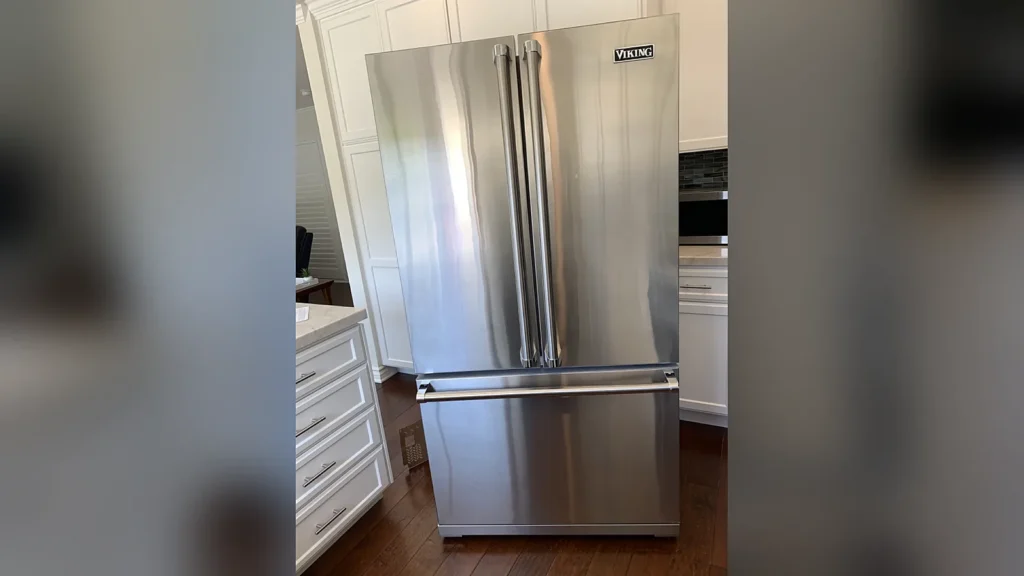
Short answer: If your Viking refrigerator is not cooling, first confirm the power switch behind the top grille (on built-ins) is on and the grille isn’t blocked. Then the usual causes, in order: a dirty condenser or failed fan, a defrost sensor or heater, the control, and the sealed system. Common built-in repairs typically run $220–$460 in Los Angeles.
This is for owners of Viking built-in (5 Series and 7 Series) and freestanding refrigerators whose fresh-food or freezer section has gone warm: what to check, the causes in order, condenser cleaning, Viking’s warranty and Los Angeles prices.
How Viking built-ins differ from other refrigerators
A Viking built-in refrigerator keeps its machinery at the top. The compressor and condenser sit in a machine compartment behind the top grille, and the power switch is up there too. A condenser is the coil that releases the heat pulled from the food compartments.
Viking says 5 Series built-ins have one variable-speed compressor, while 7 Series built-ins have two, so each compartment runs independently. On a 7 Series, a warm fresh-food side with a cold freezer can be that side’s own sealed system; on a 5 Series it’s usually airflow. Freestanding Viking models, like the French-door refrigerator pictured above, are laid out differently, so use the manual for yours to find the condenser.
What to check first
Six no-tool checks come first on a Viking refrigerator that isn’t cooling:
- The power switch. On built-ins it sits behind the top grille (top right in the manuals we checked) and can get bumped during cleaning. If the unit is dark and silent, check it and the breaker.
- The settings. Viking factory-sets built-ins to 38°F in the refrigerator and 0°F in the freezer. After any change, allow 24 hours for temperatures to settle.
- The top grille. Make sure nothing is stored against it and no trim blocks it; the condenser breathes through it.
- The doors and gaskets. Check that both doors close fully. Viking’s manual says to clean the door gaskets every three months and wipe on a light coat of petroleum jelly afterward.
- The freezer’s rear panel. Frost or snow-like buildup there points to a defrost problem or an air leak.
- The display. Write down any alert exactly as shown.
Where to stop: Viking’s use and care manual (on Viking’s documentation page) says to turn the power off before removing the top grille and warns not to touch the condenser coils near the defrost pan, because they can burn you. Fan blades and wiring sit behind the grille, so don’t reach in with the power on.
Why is my Viking refrigerator not cooling?
A Viking refrigerator that passes the simple checks but still isn’t cooling usually has one of five problems, listed in the order we check them.
1. A dirty condenser or a failed condenser fan
Viking calls its built-in condenser clog-resistant and maintenance-free under normal conditions, but its manuals still say to vacuum the coils when they’re dusty. When dust, pet hair or grease stops the condenser shedding heat, both compartments warm; a dead condenser fan does the same, faster. Tell: little or no air moving at the grille.
2. A failed evaporator fan
The evaporator fan behind the rear panel moves air across the cold coil; when it fails, that compartment warms while the compressor runs. Tell: no fan sound inside.
3. A defrost failure
A defrost heater melts frost off the coil, and a defrost sensor tells the control when to start and stop. When one fails, frost or ice builds until air can’t pass. We wrote up one of these on a Viking 5 Series in Beverly Hills with snow-like frost in the freezer.
4. A temperature sensor or the control board
A thermistor is a temperature sensor; if one reads wrong, the control won’t call for cooling. A display that disagrees with a thermometer is the clue. We test sensors and the control’s outputs before quoting a board.
5. The sealed system
If the condenser is clean, the fans run and both sides still warm, the problem is in the sealed system: a refrigerant leak or a weak compressor. On a 7 Series it can affect one compartment only.
How do you clean the condenser on a Viking built-in?
Viking lists vacuuming the coils as owner maintenance. Use a sturdy step stool and follow your manual; these steps follow Viking’s built-in manuals:
- Remove the center grille blade and turn the power switch off.
- Remove the top grille.
- Vacuum the condenser coils with a narrow attachment or soft brush, without bending the fins.
- Stay clear of the coils near the defrost pan, which can be hot.
- Refit the grille and turn the power switch back on.
If the refrigerator still isn’t cold 24 hours after a cleaning, a fan or another part has likely failed. Our guide to a refrigerator running constantly covers the same heat problem on other brands.
How much does Viking refrigerator repair cost?
Viking built-in refrigerator repairs in Los Angeles typically run $220–$460 for condenser, fan, sensor and defrost work and $900–$1,900 for sealed-system work, parts and labor included. The exact price is written before work starts.
| Repair | Signs | Typical LA price (built-in) |
|---|---|---|
| Condenser cleaning plus fan motor | Both sides warming; dusty coils; no air at the grille | $220–$420 |
| Thermistor or defrost component | Frost on the rear panel; display disagrees with a thermometer | $240–$460 |
| Electronic control board | Parts test good but get no power | $450–$950 |
| Evaporator or sealed-system repair, one loop | Warm with a clean condenser and running fans | $900–$1,900 |
Freestanding Viking models are usually quoted in our standard refrigerator ranges: fan motors $190–$340, defrost parts $190–$360, control boards $280–$620 and sealed-system work $650–$1,400. The refrigerator diagnostic is $85, applied to the repair you approve, with the same fees across both counties and no travel charge.
Built-in refrigeration typically lasts 18–20 years, so repairs almost always pass our 50% rule: repair when the quote is under half the price of a comparable new unit and the refrigerator has life left.
Viking warranty and independent repair
Check the Viking warranty before paying for any repair. Viking’s current warranty covers built-in and freestanding refrigerators for two years from purchase or new-construction closing, whichever is longer (older manuals list three). The sealed system (compressor, evaporator, condenser, connecting tubing and dryer/strainer) has parts and labor through year 6, then the part only in years 7–12, with you paying labor. Viking says warranty service must go through its own service network.
Pros Fix Appliances is independent, not Viking-authorized. If your refrigerator is inside its warranty, call Viking first. Outside it, we repair Viking refrigerators with OEM parts whenever available. Parts are ordered by the model and serial number, and when one has to be ordered, installing it takes a second visit.
When to call a technician
Call a technician if the Viking refrigerator is still above 40°F a day after the checks and a condenser cleaning, or right away if both compartments are warm, frost keeps returning, a fan is silent or the display shows an alert. Calls placed before noon are usually seen the same day across Los Angeles County and Orange County. See our refrigerator repair page, call (866) 696-7767 or book online.
Frequently asked questions
How often should I clean the condenser on a Viking built-in?
Viking sets no fixed schedule: its manuals call the condenser maintenance-free under normal conditions and say to vacuum the coils when they’re dusty or dirty. A practical habit is to look behind the top grille whenever you do Viking’s three-month door gasket cleaning, and sooner in homes with pets or nearby remodeling.
Why is my Viking freezer cold but the refrigerator warm?
On a 5 Series built-in, which has one compressor, it’s usually airflow: frost from a defrost failure, a failed fan or a faulty sensor. On a 7 Series, each compartment has its own compressor, so the fresh-food side’s own sealed system is also a suspect.
Is my Viking refrigerator still under warranty?
Viking’s current warranty lists two years on the whole refrigerator from purchase or new-construction closing, then sealed-system parts and labor through year 6 and the sealed-system part only in years 7–12. Older manuals list three years on the whole unit, so check the warranty page in yours.
Is a Viking built-in refrigerator worth repairing?
Almost always. Built-in refrigeration typically lasts 18–20 years, and replacing a built-in can also mean cabinetry work. Even a $900–$1,900 sealed-system repair usually passes the 50% rule on a built-in, and the $85 diagnostic gets you a written quote first.