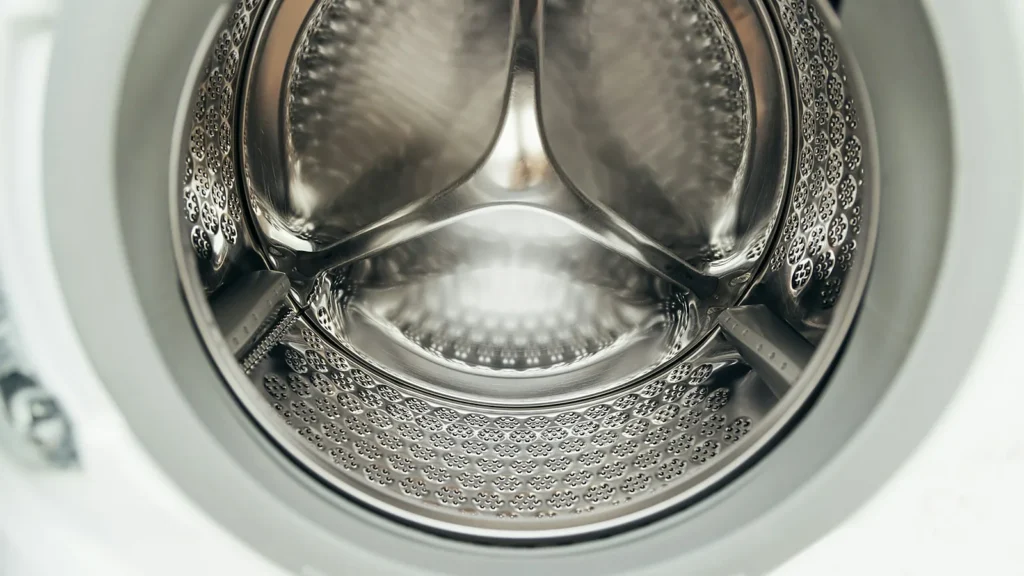
Short answer: A washing machine grinding noise usually comes from one of three places: a coin or underwire caught in the drum or drain pump, a worn drain pump, or failing tub bearings that roar louder as the spin speeds up. Removing an object is often free; a drain pump runs $190–$340 in Los Angeles and bearings $450–$750.
This guide is for anyone whose washer has started to grind, rattle or roar. It explains how to tell an object from a pump or bearing problem by when the noise happens, what you can check safely, what each repair costs in Los Angeles and when a new washer is the better buy.
What causes a washing machine grinding noise?
When the noise happens tells you most of what you need. A grind only during drain points to the pump; a scrape at any speed points to an object; a roar that builds with spin speed points to the tub bearings.
| What you hear, and when | Likely cause | First check | Typical LA price |
|---|---|---|---|
| Metallic scrape or clatter as the drum turns, any speed | Coin, key, underwire or zipper caught between the drum and the tub | Check the door boot folds and drum holes; remove with pliers | Free if reachable |
| Grinding or rattling only while water pumps out | Object in the drain pump or its filter, or a worn pump impeller | Clean the pump filter (front-load) | Free, or drain pump $190–$340 |
| Roar or rumble that rises with spin speed; may leak rusty water | Worn tub bearings, usually after the seal let water in | Hand-turn the empty drum and feel for roughness | Tub bearing and seal $450–$750 |
| Squeal or grind during agitation or spin on an older top-loader | Worn drive parts: belt, pulley, coupler or transmission | Technician check | Priced after diagnosis |
| Loud bang or hammering on spin in a new install | Shipping bolts or brackets still in place | Check the back of the washer for them | Free to remove |
Coins, underwire and small objects
This is the cheapest cause and a common one. Coins, keys, bra underwires and hairpins slip through the drum holes or the door boot and scrape between the drum and the outer tub. LG’s support pages, for example, tell owners to remove a coin caught in the tub with pliers or tweezers, and on top-loaders to check the gap between the tub and the washboard.
The drain pump
The drain pump is a small electric pump that pushes water out of the washer. When a coin or button reaches its impeller, it grinds or rattles only while the water drains, then goes quiet. On front-loaders, most of these objects stop in the pump filter behind the small cover at the bottom front. A pump that still grinds with a clean filter, or hums without moving water, needs replacing.
Worn tub bearings
Tub bearings are the steel ball bearings that carry the drum’s shaft, behind the drum on a front-loader and beneath it on a top-loader. A seal keeps water out of them. When that seal wears, water reaches the bearings, they rust, and the washer starts to rumble on spin, then roar. The tells are a noise that rises with spin speed, roughness when you turn the empty drum by hand, play when you lift a front-loader’s drum by its front edge, and rusty streaks under the washer.
Drive parts
Older top-loaders that use a belt or a transmission can grind or squeal when a pulley, coupler or the transmission wears. On front-loaders, a loose drive pulley or a corroded drum support (the “spider” behind the drum) can knock or scrape. The technician tells these apart by turning the drum by hand and inspecting the drive.
What can you check yourself?
Most of these checks need only a flashlight and pliers. Unplug the washer before you reach into the drum, the boot or the filter.
- Empty the drum and listen once more. Run a short Rinse and Spin with nothing in it. If the noise is gone, it was something in the load, such as a zipper or a belt buckle.
- Check the door boot (front-load). Fold back the rubber gasket all the way around and remove coins, hairpins and socks.
- Look through the drum holes. With a flashlight, look for a wire or coin stuck in a hole. Pull it free with needle-nose pliers if you can reach it.
- Clean the pump filter (front-load). Lay towels and a shallow pan down, open the small cover at the bottom front, drain the water slowly, then unscrew the filter and clear it.
- Turn the drum by hand. It should turn smoothly and quietly. Rumbling, roughness, or (on a front-loader) play when you lift the drum’s front edge means bearings.
Stop there. Don’t remove the heater or the back panel to fish objects out from behind the drum; that means opening the cabinet near wiring. Stop also if water is leaking under the washer, you smell burning, or the noise came with a tripped breaker.
Are bad washer bearings worth fixing?
Sometimes. A tub bearing and seal repair runs $450–$750 in Los Angeles because the washer has to be taken apart down to the tub. On some front-load designs the bearings are sold only as part of a new outer tub, so the technician confirms which design you have before quoting.
We use the 50% rule: repair when the quote is under half the price of a comparable new washer and the washer has life left. Mainstream washers last roughly 10–12 years, so bearings on a washer under about 6 years old, or on a premium model, usually pass the test. Bearings on a mainstream washer past about 8 years usually don’t, and we’ll tell you so at the diagnostic rather than sell you the repair.
When should you call a technician?
Call when the noise stays after the drum, boot and filter checks, when the drum feels rough or loose by hand, or when the noise comes with a leak.
Calls placed before noon are usually seen the same day across Los Angeles County and Orange County. The washer diagnostic is $69, applied to the repair you approve, with the same fees in both counties and no travel charge. Have the model number from the label inside the door or lid frame ready, then call (866) 696-7767 or book online. If the washer is also leaking, read where washer leaks come from; if it bangs rather than grinds, read why a washer shakes violently. All washer repair prices are on our washer repair page.
Frequently asked questions
Is it safe to keep using a washer that is grinding?
Stop using it. A coin or underwire can crack the drain pump or tear the door boot, and worn bearings get worse every spin until the drum drags or the seal leaks. If the noise is new, empty the drum and check for objects before running another load.
How do I know if my washer bearings are bad?
With the washer unplugged and empty, turn the drum by hand. A rumble or roughness you can feel, play when you lift a front-loader’s drum by its front edge, or rusty streaks under the washer point to worn bearings. The noise also grows louder as the spin speeds up.
Why does my washer grind only when draining?
A noise that starts when the water pumps out and stops when draining ends comes from the drain pump. Usually a coin, button or hairpin is spinning in the pump or its filter; sometimes the pump’s impeller is worn. On front-loaders, clean the filter first. If the noise stays, the pump needs replacing, $190–$340 in Los Angeles.
Should I replace the bearings or buy a new washer?
Use the 50% rule. A tub bearing and seal repair is $450–$750 in Los Angeles. On a washer under about 6 years old, or a premium model, that usually passes. On a mainstream washer past about 8 years, and especially when the tub must be replaced too, a new washer usually wins.