Short answer: A refrigerator running constantly usually can’t move heat fast enough: dirty condenser coils, a failed condenser fan, a leaking door gasket, frost on the evaporator or a hot garage. Clean the coils and test the seal first. If it still never stops and feels warm, most repairs run $190–$360 in Los Angeles; a weak compressor costs $650–$1,400.
This is for anyone whose refrigerator hums day and night, whether it’s the kitchen fridge or a second one in a hot garage. It explains what’s normal, the six causes in order, safe coil cleaning, repair costs and when to call.
How long should a refrigerator run?
A refrigerator normally runs far more than most people expect. LG’s owner’s manual for its LFCS27596S French-door model says that at a room temperature of 70°F the compressor runs about 40% to 80% of the time, and longer in warm weather. Newer refrigerators with variable-speed (inverter) compressors are designed to run long and slow, so a quiet, steady hum isn’t a problem by itself.
Constant running matters when it comes with other signs: the fridge above 40°F (the FDA’s upper limit for refrigerated food), a compressor that never cycles off, a hot, loud compressor area, or frost where it shouldn’t be.
Why is my refrigerator running constantly?
A refrigerator runs constantly when it can’t remove heat as fast as heat gets in. These are the six causes in the order we find them on service calls across Los Angeles County and Orange County.
1. Dirty condenser coils
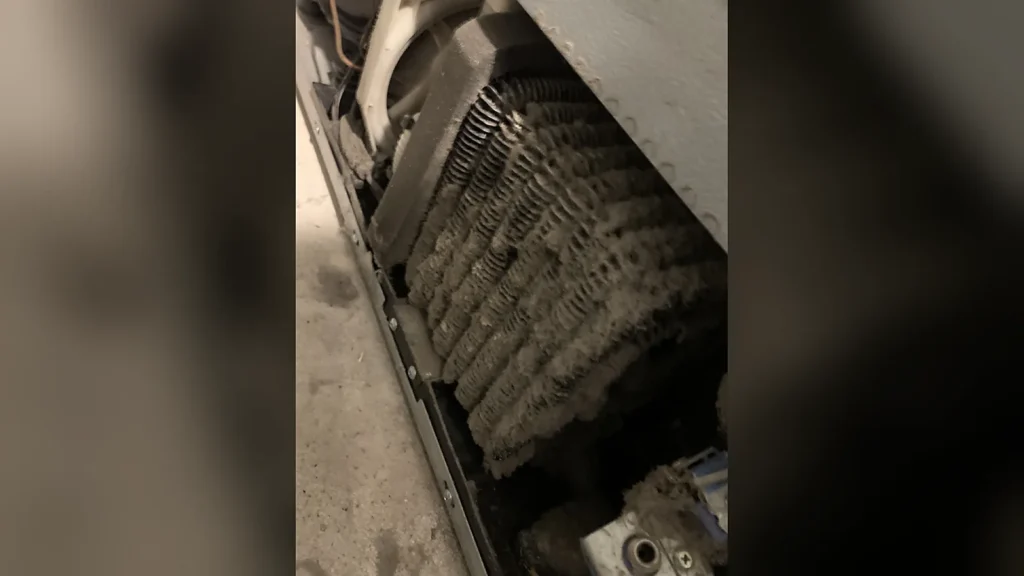
The condenser is the coil that releases the heat taken out of the food compartments. Dust, lint and pet hair blanket it, like the coil pictured above, and the compressor runs longer to get the same cooling. Whirlpool says coils may need cleaning as often as every other month in dusty homes or homes with many pets.
2. A failed condenser fan
On most freestanding refrigerators a small fan near the compressor pulls air across the condenser. If it stops, heat builds, the compressor runs nonstop and both compartments slowly warm. Tell: no airflow at the bottom of the unit while the compressor hums.
3. A leaking door gasket or a door that doesn’t close
Warm, humid kitchen air leaks in, and the refrigerator never catches up. Tells: sweat or frost along the gasket, a dollar bill that slides out of the closed door, or a door that doesn’t swing shut. Our door seal guide shows the test.
4. Frost on the evaporator
When the defrost system fails, frost chokes the evaporator coil behind the freezer panel, airflow drops and the control keeps the compressor running. Tell: frost or ice across the freezer’s back wall. See our guide to frost building up in the freezer.
5. A hot location or heavy use
A refrigerator next to an oven, a dishwasher or a sunny window, or one loaded with warm groceries, runs longer for a while. Whirlpool and LG both say their refrigerators shouldn’t run in rooms above 110°F.
6. A sensor fault or a weak compressor
A thermistor (temperature sensor) that reads warm keeps the compressor on. A refrigerant leak or worn compressor leaves it running without pulling the temperature down. A technician confirms these last suspects with temperature and power readings.
How do you clean refrigerator condenser coils safely?
Cleaning the coils is the one fix most owners can do, and it costs nothing. Check your manual first, because coil location and access vary:
- Unplug the refrigerator, or switch off a built-in’s power switch.
- Find the coils. Most freestanding models have them behind the front base grille or a rear lower panel; some built-ins, including Viking’s, have them at the top behind the grille. Some brands, including LG, say to vacuum the rear cover and vents and not remove the panel over the coils.
- Pull the refrigerator out carefully if you need the back, watching the water line and your floor.
- Vacuum with a brush attachment or a coil brush, working along the fins. Clear the condenser fan blades only if you can reach them without removing anything.
- Refit the grille or cover, push the unit back with the clearance your manual asks for, and plug it in.
- Wait 24 hours, then check the temperature with an appliance thermometer.
Where to stop: don’t remove panels that cover wiring, the compressor or the control board; keep fingers away from fan blades; and don’t touch tubing near the drain pan or the compressor, which can be hot. We suggest cleaning the coils every spring, before the hot months. Our refrigerator maintenance checklist covers the rest of the routine.
Energy use and garage refrigerators
A refrigerator that runs constantly uses more electricity, because the compressor uses most of a refrigerator’s power, and it wears the compressor and fans sooner. ENERGY STAR recommends clean coils, airtight door seals, a setting of 35–38°F and a spot away from ovens, dishwashers and direct sun.
Garage refrigerators work hardest. During a heat wave, a garage in the San Fernando Valley or inland Orange County can approach the 110°F limit, and the compressor may barely rest. Give it shade, clean coils and room to breathe, or ask whether the garage is the right place for it.
Signs, fixes and LA repair prices
Most repairs for a refrigerator that runs constantly cost $190–$360 in Los Angeles, parts and labor; a weak compressor or refrigerant leak runs $650–$1,400. The exact price is written before work starts.
| Cause | Signs | Fix | Typical LA price |
|---|---|---|---|
| Dirty condenser coils | Furry coils; cabinet sides warm | Clean the coils | Free if you do it |
| Condenser fan motor | No airflow at the bottom; compressor hot | Replace the fan motor | $190–$340 |
| Door gasket or door alignment | Sweating or frost at the seal; bill slides out | Adjust the door or replace the gasket | Quoted by model |
| Defrost failure | Frost on the freezer’s back wall | Replace heater, thermostat or sensor | $190–$360 |
| Thermistor or control board | Display disagrees with a thermometer | Replace the sensor or board | $190–$360 sensor; $280–$620 board |
| Weak compressor or refrigerant leak | Runs nonstop, can’t pull down; coils clean, fans fine | Sealed-system repair | $650–$1,400 |
The refrigerator diagnostic is $85, applied to the repair you approve; same fees across both counties, no travel charge. Fans, defrost parts and sensors almost always pass our 50% rule: repair when the quote is under half the price of a comparable new unit and the refrigerator has life left, roughly 10–12 years for mainstream models. A sealed-system repair on an older mainstream refrigerator often doesn’t.
When to call a technician
Call a technician if the refrigerator still runs nonstop 24 hours after a coil cleaning, if the fridge is above 40°F, or if you see frost on the freezer’s back wall or hear no condenser fan. Unplug it and call if the compressor clicks on and off repeatedly, smells hot or trips the breaker.
Calls placed before noon are usually seen the same day across Los Angeles County and Orange County. See our refrigerator repair page, call (866) 696-7767 or book online.
Frequently asked questions
Is it normal for a refrigerator to run all the time?
It can be. LG’s LFCS27596S manual says a compressor normally runs about 40% to 80% of the time at 70°F, and newer variable-speed compressors are designed to run long and slow. It’s a problem when the fridge is above 40°F, the compressor never cycles off, or the compressor area is hot and loud.
How often should refrigerator coils be cleaned?
Whirlpool says as often as every other month in dusty homes or homes with many pets. For most kitchens, once a year before the hot months is a good habit. Unplug the refrigerator first and follow your manual, since some models ask you to vacuum the rear cover rather than remove it.
Why does my garage refrigerator run constantly in summer?
A hot garage makes the compressor run much longer, and LG and Whirlpool both say their refrigerators shouldn’t run in rooms above 110°F. Keep the coils clean, leave clearance behind the unit and keep it out of direct sun. If it still can’t hold 40°F, the garage may be too hot for it.
Does a refrigerator that runs constantly mean the compressor is bad?
Usually not. Dirty coils, a failed condenser fan, a leaking gasket or frost on the evaporator are much more common. A weak compressor or refrigerant leak is the last suspect, confirmed with temperature and power tests before anyone quotes the $650–$1,400 sealed-system price.