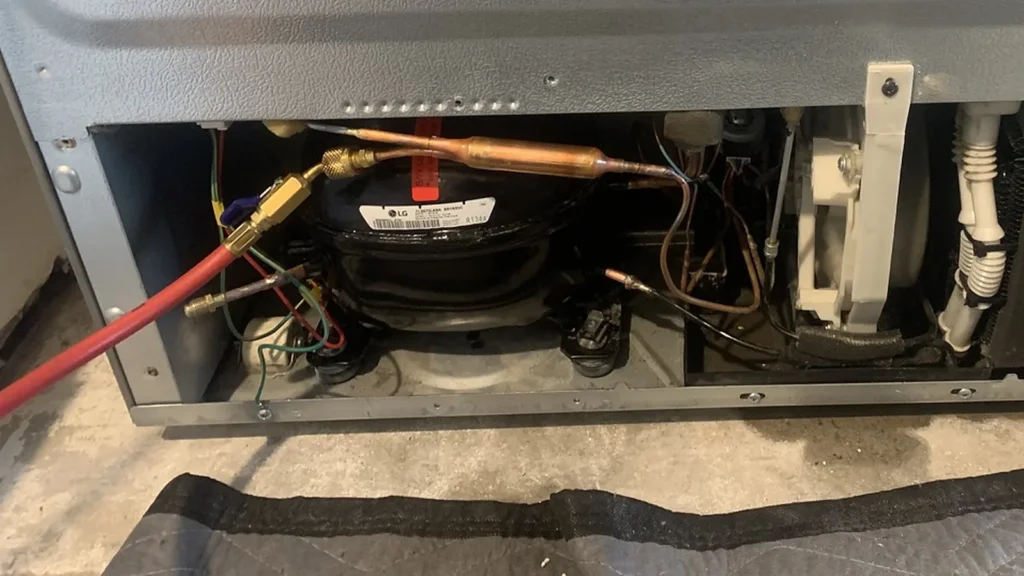
Short answer: A chest freezer clicking but not running is usually trying to start its compressor and failing: the overload protector clicks off, cools and tries again. The usual culprit is the start relay ($150–$260 in LA); low voltage from an extension cord, a hot garage or a failing compressor ($600–$1,300) are the others. Most chest freezers have no defrost timer.
This guide is for anyone whose chest freezer clicks every few minutes but never hums into a normal run, usually in a garage, often during a heat wave. It explains what that click means, what you can safely check, why garage heat matters in Los Angeles, and when a repair is worth paying for.
Why is my chest freezer clicking but not running?
The click is the compressor trying to start and giving up. When you hear a click, maybe a short buzz, then silence for a few minutes and another click, the compressor isn’t turning over. Its overload protector, a heat-sensing switch on the side of the compressor, cuts power to keep it from burning out, cools down and lets it try again. Meanwhile the cabinet slowly warms.
The part that gets the compressor going is the start relay, a small plug-on device on the compressor’s terminals. It’s the cheapest and most common failure behind this symptom. A compressor that is seized or electrically damaged makes the same sound, which is why a technician tests both before quoting.
A single click followed by a steady hum is normal: that’s the temperature control switching the compressor on. A warm cabinet exterior while it runs is normal too; GE notes the freezer sheds heat through its outer walls.
Is a clicking chest freezer a bad defrost timer?
Almost never. Most chest freezers are manual-defrost, so they have no defrost timer or defrost heater to fail; Frigidaire’s garage-ready chest models, for example, are listed as manual defrost. That clicking-timer explanation applies to frost-free refrigerators and frost-free upright freezers. A chest freezer’s frost is removed by hand: Frigidaire says to defrost when ¼ to ½ inch builds up, and GE says about twice a year in most climates. Heavy frost makes a freezer work harder, but it doesn’t make it click.
What causes it, and what does each fix cost?
| Cause | Tell | Fix | Typical LA price |
|---|---|---|---|
| Low voltage (extension cord, power strip, shared circuit) | Clicks when other garage tools or appliances run | Plug straight into a wall outlet | Free |
| Overheating (hot garage, no clearance, direct sun) | Starts at night, clicks in afternoon heat | Clear space around it, shade it, cool the garage | Free |
| Failed start relay or overload | Click every few minutes, short buzz, cabinet warming | Replace the relay and overload | $150–$260 |
| Failing compressor | Still clicks with a new relay, or trips the breaker | Sealed-system repair, or replace the freezer | $600–$1,300 |
| No power at all (not clicking) | Silent, no click, no light | Reset a tripped GFCI or breaker | Free |
Prices are for Los Angeles County and Orange County, parts and labor. The exact price is written before any work starts. When a technician tests for low voltage, the check is the reading at the moment the compressor tries to start: a supply that sags below about 105 volts can stall it even with good parts.
What can you safely check yourself?
Start with power and heat; they’re free to fix. Don’t open the compressor’s terminal cover or touch the relay while the freezer is plugged in.
- Keep the lid closed. According to FoodSafety.gov, a full freezer holds a safe temperature for about 48 hours and a half-full one for about 24.
- Plug it straight into a wall outlet. Remove any extension cord or power strip; a long or light-duty cord can starve the compressor at start-up.
- Give it air. Pull it a few inches from the wall and clear boxes away from the sides and the compressor grille.
- Let it cool, then retry. Unplug it for about 15 minutes so a hot compressor and overload can cool, then plug it in and listen. A steady hum that keeps going is good news; another click-and-quit cycle points to the relay or compressor.
- If it’s silent, check the outlet’s GFCI button and the breaker before anything else.
Stop and call if you smell burning, see scorch marks at the outlet or plug, or the breaker trips each time it tries to start.
Why do garage freezers fail in Los Angeles heat?
A compressor starting in a hot garage is working at its limit, and a weak relay that copes in winter gives out in a heat wave. Valley garages get that test every summer: Woodland Hills reached 121°F on September 6, 2020, at the time the highest temperature on record for Los Angeles County, according to the National Weather Service, and a closed garage can run hotter than the air outside.
Check the manual for your freezer’s rated room-temperature range. Frigidaire’s garage-ready chest freezers are rated to perform from 0°F to 110°F; models without that rating are made for a narrower range. For garage freezers in Woodland Hills and the rest of the West Valley, that means keeping them off sun-facing walls and giving them clearance on all sides.
Should you repair it, replace it, or call now?
Repair a bad relay or overload: at $150–$260 it’s almost always worth it. A failed compressor is different. Sealed-system work runs $600–$1,300, which on most chest freezers is more than half the price of a new one, so under the 50% rule replacement usually wins, and we’ll say so in the written quote.
The freezer diagnostic is $85 and is applied to the repair, with the same fees in Los Angeles County and Orange County and no travel charge. Calls placed before noon are usually seen the same day; later calls typically the next business day. Call (866) 696-7767 or book online, and see our freezer repair service for upright and built-in units too.
If your freezer runs but won’t get cold, see freezer not freezing; for a kitchen refrigerator that clicks, see refrigerator clicking noise.
Frequently asked questions
Is it normal for a chest freezer to click?
One click when the compressor starts or stops is normal, followed by a steady hum while it runs. A click every few minutes with no steady hum, while the cabinet slowly warms, is not normal: the compressor is failing to start and its overload protector keeps tripping.
How long will food last in a chest freezer that isn’t running?
With the lid closed, a full freezer holds a safe temperature for about 48 hours and a half-full one for about 24, according to FoodSafety.gov. Food that still has ice crystals or is at 40°F or below can be refrozen, though its quality may suffer.
Can I replace a chest freezer start relay myself?
Some owners do, but it means working on the compressor’s terminals, matching the exact relay to the compressor, and knowing whether the compressor itself is good. If the freezer still clicks with a new relay, the compressor is the problem. A technician tests both in one visit; a relay job runs $150–$260 in LA.
Is it worth fixing a chest freezer with a bad compressor?
Usually not on a standard chest freezer. Compressor and sealed-system work runs $600–$1,300, which on most models is more than half the price of a new freezer. A relay, overload or lid gasket repair is a different story and is almost always worth doing.
Does a chest freezer work in a hot garage?
Only within its rated range. Frigidaire rates its garage-ready chest freezers for 0°F to 110°F; other models are rated for less, so check the manual. In a heat wave, give the cabinet clearance, keep it out of direct sun and plug it straight into a wall outlet.