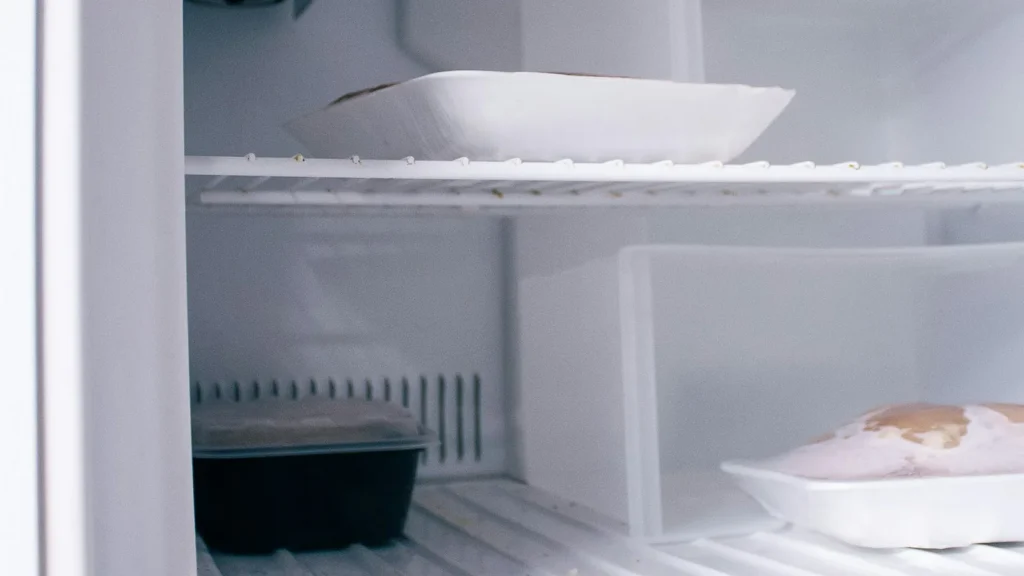
Short answer: A freezer not freezing while the fridge stays cold usually has a control set too warm, a door that isn’t sealing, or too little airflow across the evaporator coil from frost or a failing fan. If both sections are warming, suspect a refrigerant leak or the compressor. Most fan and defrost repairs run $190–$360 in Los Angeles.
This guide is for anyone whose ice cream has gone soft while the milk still feels cold. It walks through the causes in the order a technician checks them, what you can check yourself, what changes when both sections are warm, and typical repair costs in Los Angeles County and Orange County.
Why would the freezer stop freezing while the fridge stays cold?
Because the freezer needs the coldest air, it’s the first to fall short when cooling drops even a little. A freezer should hold 0°F, while a refrigerator only needs 40°F or below, the FDA’s recommended limits. Soft ice cream next to frozen-solid meat is the classic early sign.
In most refrigerators one evaporator coil, the cooling coil behind the freezer’s back panel, cools both sections. A fan blows air across it and a damper or vent sends part of that air to the refrigerator side. A leaking door, a choked coil, a slow fan or a small refrigerant leak all trim that coil’s output, and the freezer shows it first. Built-ins with dual refrigeration, such as Sub-Zero, and some mainstream models have a separate coil and fan for each section, so on those a freezer-side part can fail on its own.
What causes a freezer not to freeze, in order?
Technicians start with the free checks and work toward the sealed system. This is the order, with the tell for each:
| Cause | Tells | Fix | Typical LA price |
|---|---|---|---|
| Control set too warm, airflow control turned toward the fridge, or a cold garage | Freezer soft but not thawing; fridge fine | Reset to the recommended settings; wait 24 hours | Free |
| Freezer door not sealing (overfilled basket, ice bucket, gasket out of its groove) | Frost near the door, ice crystals on food | Clear the door path; reseat or replace the gasket | Free, or $160–$300 for a gasket |
| Vents or the fan cover blocked by packages | Some shelves colder than others | Leave space around vents | Free |
| Dusty condenser coil or failing condenser fan | Runs nonstop; worse in a hot garage | Clean the coil; replace a dead fan | Free, or $190–$340 for a fan motor |
| Evaporator fan slow or dead | No fan sound with the door switch pressed; a squeal before it quit | Replace the fan motor | $190–$340 |
| Frost on the evaporator (defrost failure) | Even frost on the back panel; both sections drifting warm | Replace the failed defrost part | $190–$360 |
| Thermistor or control board | A thermometer disagrees with the display | Test and replace the sensor or board | Sensor quoted at diagnosis; board $280–$620 |
| Refrigerant leak or weak compressor | Compressor never stops; both sections warming over days; frost on only part of the coil | Sealed-system repair, or replace | $650–$1,400 |
A thermistor is a temperature sensor the control board reads to decide when to run the compressor and fans; if it reads wrong, the board stops cooling early.
What can you check yourself before calling?
The top half of that table can be ruled out in an afternoon. Work in this order:
- Measure it. Put an appliance thermometer between frozen packages in the middle of the freezer and read it after 5–8 hours, as a federal home-energy guide from PNNL suggests. The display often shows the setting, not the actual temperature.
- Reset the controls. Whirlpool’s factory recommendation is 37°F for the refrigerator and 0°F for the freezer; on models with an airflow control, set it back to the recommended mark. Wait 24 hours after any change.
- Close the door properly. Move packages that stop it closing, seat the basket and ice bucket, and check the gasket sits in its groove all the way around.
- Clear the vents and the fan cover on the back wall.
- Listen for the fan. While the compressor is running (a hum from the bottom-back), open the freezer and press the door switch. You should hear the fan moving air within a few seconds.
- Unplug it and vacuum the condenser coil behind the bottom grille or on the back.
- Check the room. Whirlpool notes that cold garages change how a refrigerator cycles; on many models the thermostat sits in the refrigerator section, so in a cold room the compressor barely runs and the freezer warms.
Stop and call if the fix means removing the freezer’s back panel (fan and heater wiring sit behind it), you smell burning, or the compressor clicks every few minutes without starting. Don’t chip at ice around the coil.
What if the freezer and the fridge are both warm?
Then the whole cooling system is short, not just the freezer’s share. In order, it’s usually a frosted coil, a dead evaporator fan, a compressor that won’t start, or a sealed-system leak. If the display reads OFF or OF OF and nothing is cold, the unit is in showroom mode; LG and Samsung explain how to exit it. If only the fridge is warm and the freezer is fine, see refrigerator not cooling but freezer works; if the freezer runs colder than its setting instead, see freezer too cold.
Keep the door closed meanwhile. A full freezer holds a safe temperature for about 48 hours and a half-full one for about 24, according to FoodSafety.gov.
Why is a chest or upright freezer not freezing?
Stand-alone freezers are simpler: one compressor, one coil and a thermostat. In order, check for a bumped thermostat dial, a lid or door gasket that leaks (frost along one edge), and a condenser that can’t shed heat because the unit is in a hot garage or pushed tight against a wall. After that come a failed start relay or overload, and a sealed-system leak. Most chest freezers are manual-defrost, so thick wall frost also cuts cooling; see frost building up in the freezer and, if it clicks without running, chest freezer clicking but not running.
What does a freezer repair cost, and when should you call?
Most freezer-not-freezing repairs cost $150–$360 in Los Angeles County and Orange County, parts and labor included. Sealed-system work is the exception.
| Repair | Refrigerator-freezer | Upright or chest freezer |
|---|---|---|
| Evaporator fan motor | $190–$340 | $180–$320 |
| Defrost heater, thermostat or sensor | $190–$360 | $180–$340 |
| Start relay or overload | $160–$280 | $150–$260 |
| Door gasket | $160–$300 | $160–$300 |
| Compressor or sealed system | $650–$1,400 | $600–$1,300 |
The $85 diagnostic covers the trip, testing and a written quote, and it’s applied to the repair if you approve it. Fees are the same in both counties, with no travel charge. Fans, defrost parts, relays and gaskets almost always pass the 50% rule: repair when the quote is under half the price of a comparable new unit and it has life left, roughly 10–12 years for a mainstream refrigerator. A compressor on an older basic freezer often fails that test; on an 18–20-year built-in it usually passes.
Call when the freezer stays above 0°F for a day after you’ve checked the settings and door, frost covers the back panel, or both sections are warming. Calls placed before noon are usually seen the same day; later calls are typically seen the next business day. Call Pros Fix Appliances at (866) 696-7767 or book online. More about our freezer repair service.
Frequently asked questions
How cold should a freezer be?
0°F (-18°C) or colder. The FDA recommends 0°F for freezers and 40°F or below for refrigerators, and Whirlpool and Electrolux recommend 0°F as the freezer setting. Check with an appliance thermometer between frozen packages, and allow 24 hours for the temperature to settle after changing a setting.
Why is my ice cream soft when everything else is frozen?
Ice cream contains sugar and fat that keep it soft at temperatures where meat and vegetables still feel rock hard, so it’s the first sign a freezer is running a few degrees warm. Check the setting and door seal first; if both are fine, the coil, fan or condenser is losing ground.
Is it worth repairing a freezer that won’t freeze?
Usually, when the cause is a fan, defrost part, relay or gasket, which run $150–$360 in Los Angeles. A failed compressor on an older basic chest or upright freezer often costs more than half the price of a new one; the written quote at the $85 diagnostic tells you which side of that line you’re on.