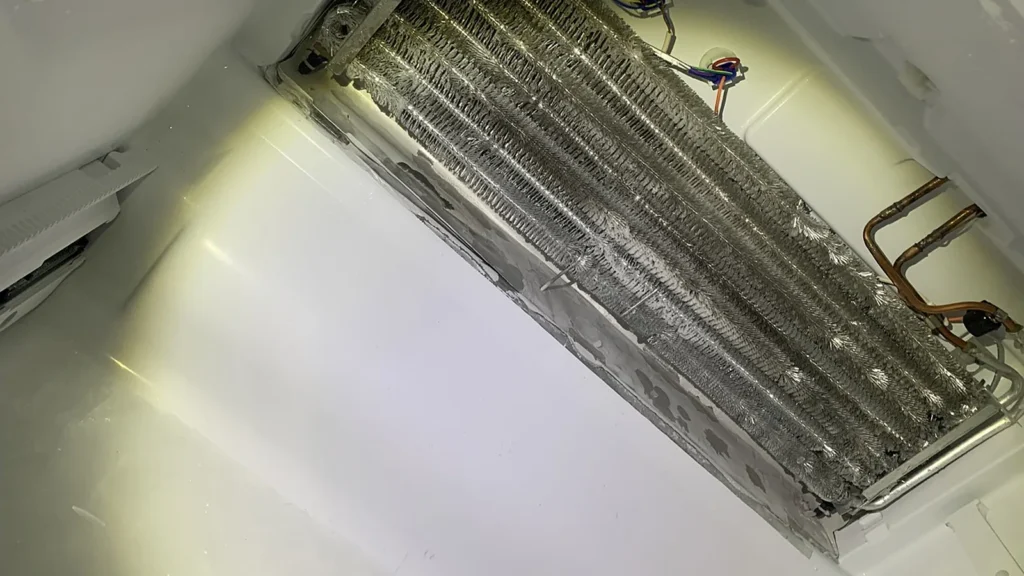
Short answer: Frost build-up in a freezer means humid air is getting in or the defrost system has failed. Frost on food and around the door points to a door left ajar or a leaking gasket, so check those first. An even sheet of ice across the back panel means a failed defrost part, typically $190–$360 to repair in Los Angeles.
This guide is for anyone finding frost on the food, ice along the door or a white sheet across the freezer’s back wall. It covers how to tell which problem you have, what you can fix yourself, how to defrost safely and what repairs cost in Los Angeles County and Orange County.
What causes frost build-up in a freezer?
Frost is moisture from the air freezing onto the coldest surface it finds. It builds up when more moisture gets in than the freezer can remove, or when the system that removes it stops working.
In a frost-free freezer, the kind in nearly every full-size refrigerator, moisture collects on the evaporator coil, the finned cooling coil behind the back panel. A defrost heater warms the coil every so often and the melt water drains to a pan under the cabinet. Most chest freezers are manual-defrost, with no defrost system, so some frost is normal there.
- Too much moisture getting in: a door left ajar, an overfilled bin that stops it closing, a torn, folded or dirty gasket (the rubber door seal), a leaning cabinet, warm food or blocked vents. Samsung’s frost troubleshooting page lists most of these.
- Frost not being removed: a failed defrost heater, defrost thermostat, timer or control board, or a clogged defrost drain.
Coastal homes, from Santa Monica to Huntington Beach, have damper air than the inland valleys, so a small gasket leak frosts up faster.
Is it the door seal or the defrost system?
Where the frost sits tells you. Door and gasket problems leave frost near the door and on the food; a defrost failure leaves an even layer on the back panel and slowly warms the refrigerator side.
| Where the frost is | Most likely cause | What to do | Typical LA price |
|---|---|---|---|
| On packages, ice crystals inside bags | Door opened often or left ajar; warm food | Shorter openings; make sure the door closes | Free |
| Along one edge or corner of the door | Gasket torn, folded, dirty or loose; cabinet not level | Clean, reseat and test the gasket | Free, or $160–$300 for a new gasket |
| Even white sheet on the back panel; fridge side warming | Defrost heater, thermostat, timer or control board | Manual defrost buys time; book a repair | $190–$360 |
| Ice on the freezer floor or water under the crisper drawers | Clogged or frozen defrost drain | Clear the drain and find out why it froze | Quoted at diagnosis |
| Only around the ice maker or ice bucket | Air leaking into an in-door ice compartment | See why a Samsung ice maker freezes up | $240–$480 |
| Slowly coating a chest freezer’s walls | Normal on manual-defrost models | Defrost before it reaches about 1/4 inch | Free |
What can you check and fix yourself?
Most door-side frost can be fixed without tools. Unplug the refrigerator before handling the gasket, as GE Appliances recommends, then work in this order:
- Make sure the door can close. Push back overfilled door bins, seat the ice bucket and drawers fully, and check that the door sits flush all the way around.
- Do the dollar-bill test. Close the door on a bill, half in and half out, and pull it slowly. You should feel drag; where it slides out freely, the seal leaks. Our guide to testing and replacing a refrigerator door seal goes further.
- Clean the gasket and the cabinet face it presses against with warm, soapy water, then dry both.
- Reseat or reshape it. Press a loose gasket back into its channel. For wrinkles, GE’s gasket instructions call for a hair dryer on the low setting while you smooth the gasket by hand.
- Level the cabinet with the front legs or rollers so the door sits flush.
- Cut the moisture. Cool hot food first, keep vents clear and keep openings short; Samsung suggests under a minute at a time.
Stop and call if the fix means removing the freezer’s back panel (the heater, fan and wiring are behind it), water has reached the outlet or cord (switch off the breaker first), or the refrigerator side is above 40°F.
How do you defrost a frosted-over freezer safely?
Unplug it, move the food and let the frost melt with the doors open.
- Pack the food tightly into coolers with ice. Food that still has ice crystals or is at 40°F or below can be refrozen, says FoodSafety.gov.
- Unplug the refrigerator or switch off its breaker, prop the doors open and lay towels down, away from the outlet.
- Wipe softened frost away with a cloth or plastic scraper. Never chip at it with a knife or ice pick: one slip punctures the evaporator tubing and turns a defrost repair into a sealed-system repair.
- Skip the hair dryer inside the cabinet; Samsung warns it damages the refrigerator.
- Dry everything, plug it in, and reload once the freezer is back to 0°F.
On a manual-defrost freezer, that is the whole job. On a frost-free freezer it confirms the diagnosis but fixes nothing.
Why does the frost come back after defrosting?
Because a part of the defrost circuit has failed, and melting the ice doesn’t replace it. Frost returning to the back panel within a week or two is the classic sign. A technician tests four things:
- Defrost heater: a heating element on the evaporator coil. Heaters burn open, and a meter shows it quickly.
- Defrost thermostat or sensor: a temperature switch on the coil that cuts power to the heater once the coil is clear. Many newer models use a thermistor, a temperature sensor read by the control board, instead.
- Timer or control board: if it never calls for a defrost, every other part tests good.
- Defrost drain: if the tube clogs or freezes, melt water refreezes on the freezer floor.
Ticking or scraping from inside the freezer means the fan blade is hitting ice. A refrigerator side that warms over a week or two means frost is blocking the airflow that cools it, as our guide to a warm fridge with a cold freezer explains.
What does it cost, and when should you call?
Most frost repairs cost $160–$360 in Los Angeles County and Orange County, parts and labor included: a door gasket $160–$300, a defrost heater, thermostat or sensor $190–$360, and a control board $280–$620. Built-ins such as Sub-Zero run $240–$460 for a thermistor or defrost part. The $85 refrigerator and freezer diagnostic covers the trip, testing and a written quote, and it’s applied to the repair if you approve it.
Those repairs nearly always pass the 50% rule: repair when the quote is under half the price of a comparable new unit and the appliance has life left, roughly 10–12 years for a mainstream refrigerator and 18–20 for built-in refrigeration.
Call when frost covers the back panel, returns after a defrost, or the refrigerator side rises above 40°F (the freezer above 0°F), the FDA’s limits. Pros Fix Appliances charges the same fees across both counties, with no travel charge. Calls placed before noon are usually seen the same day; later calls are typically seen the next business day. Call (866) 696-7767 or book online, and have the model number from the plate inside the door ready. More about our freezer repair service.
Frequently asked questions
Is some frost in a frost-free freezer normal?
A light dusting after the door has been open, gone after the next defrost cycle, is normal on humid days. Frost that keeps thickening, or a white layer across the back panel, is not; it points to an air leak at the door or a failed defrost part.
Can frost build-up damage a freezer?
Yes, if it’s left for weeks. Ice on the evaporator coil blocks airflow, so the compressor runs longer and the refrigerator side warms, and the fan blade can strike the ice until the motor fails. Fixing a defrost part early usually avoids a second repair.
Does frost build-up mean the freezer is low on refrigerant?
Rarely. Heavy, even frost points to the defrost system or an air leak. A refrigerant leak usually does the opposite: only the first part of the evaporator coil frosts while the rest stays bare, and the freezer slowly warms. A technician reads that frost pattern before recommending sealed-system work.