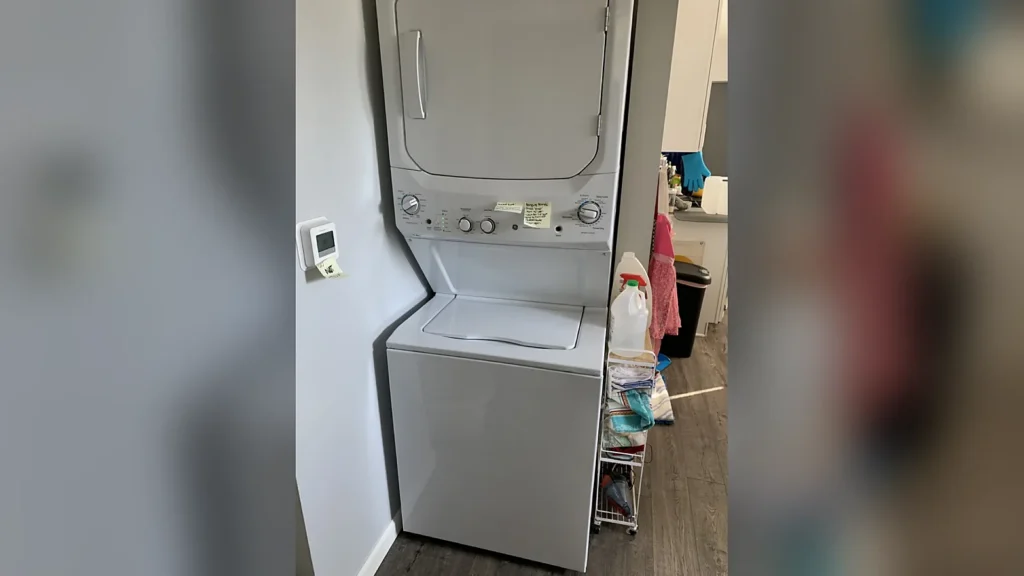
Short answer: Stacked washer dryer repair usually involves the same parts as standalone machines (a restricted dryer vent, worn drum rollers or belt, a washer drain pump or door lock), but access changes the job. One-piece laundry centers are mostly serviced from the front; stackable pairs sometimes have to be separated. Most repairs cost $140–$420 in Los Angeles.
This guide is for condo owners, renters and property managers with a stacked washer-dryer tucked into a closet or alcove. The failures are familiar ones, but closets, long condo vents and building rules change how the repair goes. It covers how to tell which type you have, what usually fails, what you can check, and what repairs cost in Los Angeles and Orange County.
One-piece laundry center or stackable pair?
The controls tell you which kind of stacked washer-dryer you have. A one-piece laundry center (a unitized washer-dryer) is a single appliance: a top-load washer below, a dryer above and one control panel between them, like the unit in the photo at the top of this guide, from one of our service calls. They come 24 or 27 inches wide.
A stackable pair is two separate front-load machines, with the dryer fixed on top of the washer by a stacking kit. Compact 24-inch pairs are common in condos, and many of those dryers are ventless condenser or heat-pump models. The difference matters for repairs: a laundry center shares one frame, while on a pair, parts reached through the washer’s top or back usually mean lifting the dryer off first.
What usually fails on a stacked washer-dryer?
A stacked washer-dryer fails in the same places as standalone machines. Typical Los Angeles prices, parts and labor, with the exact price in writing after diagnosis:
| Part | Symptom | Half | Typical LA price |
|---|---|---|---|
| Restricted vent or crushed duct | Two cycles to dry, hot closet | Dryer | See the vent cleaning cost guide |
| Thermal fuse or thermostat | No heat, often after slow drying | Dryer | $140–$240 |
| Heating element (electric) | Tumbles but blows cold | Dryer | $180–$320 |
| Belt, rollers and idler | Thumping or banging, squealing, drum won’t turn | Dryer | $190–$340 |
| Drain pump or clogged pump filter | Water left in the drum, won’t spin | Washer | $190–$340 |
| Lid or door lock | Won’t start or spin; door stays locked | Washer | $160–$300 |
| Door boot (front-load) | Leak at the door, musty smell | Washer | $220–$420 |
| Inlet valve | Won’t fill, or fills slowly | Washer | $170–$300 |
| Control board | Dead or erratic panel | Either | Dryer $260–$520; washer $280–$560 |
| Tub bearing | Roar or grind on spin | Washer | $450–$750 |
On the washer side, drain problems lead: socks, coins and hair ties end up in the pump or its filter. A front-load door stays locked while water is inside, so a drain fault can look like a lock fault. On the dryer side, airflow is the big one, followed by drum parts you’ll usually hear before they fail.
Why do stacked dryers take so long to dry?
A stacked dryer in a condo usually dries slowly because of airflow, power or design. Three conditions are common:
- Long or crushed vents. The laundry closet often sits mid-unit, so the duct runs through ceilings to an outside wall or the roof, and there’s rarely room behind the unit, so foil duct folds flat when it’s pushed back. AHAM’s guidance is rigid or semi-rigid sheet-metal vent, never plastic, as short and straight as possible; a slim metal “periscope” duct fits tight spaces without kinking.
- Building power. Some large buildings supply 208 volts, which leaves a 240-volt heating element with about three-quarters of its rated heat.
- Closet air and ventless designs. A dryer in a closed closet needs air to draw in, and closet installation manuals often require openings in the door. Ventless condenser and heat-pump dryers take longer by design and need their lint filters and condenser cleaned.
For the full list of causes, see why a dryer takes too long to dry.
Access, closets and unstacking
Access is the hard part of stacked washer-dryer repair. A unit in a closet has to come out without tearing the floor or straining the water hoses, drain hose, power cord or, on a gas dryer, the gas line. Lifting a dryer off a stackable washer is a two-person job, and the stacking kit has to go back on securely. When you book, tell us it’s stacked, whether it’s one piece or a pair, the closet width, and the building details: floor, elevator, parking and service hours.
Condo, HOA and rental rules
- Vendor paperwork. Many buildings require a certificate of insurance (COI) before a vendor gets access; Pros Fix Appliances provides one on request.
- Access rules. Service hours, elevator reservations, parking and water-shutoff procedures vary by building; the management office knows them.
- Who pays. In-unit appliances are typically the owner’s, but a duct through common walls or the roof may be the HOA’s under your CC&Rs. Renters should report it to the landlord first if the unit came with the apartment.
Safe checks before you call
- Power: switch the laundry breaker, often a double breaker, fully off and back on.
- Dryer lint screen: clean it every load, and wash it if water pools on the mesh.
- Washer pump filter (front-load pairs): most front-loaders have one behind a small door at the bottom front. Unplug the washer, lay down towels and a shallow pan, then clear socks, coins and lint. Top-load laundry centers generally have no user filter.
- Doors: make sure nothing is caught in the washer door or lid, and that the dryer door closes fully.
Stop and call if water is on the floor near an outlet or wiring (switch off the breaker before stepping in), you smell burning, the breaker trips again, or the unit has to come out of the closet. Don’t unstack a pair alone. If you smell gas, leave and call SoCalGas at 1-800-427-2200 or 911 from outside.
How much does stacked washer dryer repair cost?
Stacked units follow the same price ranges as standalone machines: most washer repairs run $160–$420 and most dryer repairs $140–$340, with control boards and tub bearings higher. Where a job lands depends on the part and how much has to come apart. The diagnostic is $69 for a washer or dryer, applied to the repair, with no travel charge across Los Angeles County and Orange County.
Repair or replace? Use the 50% rule: repair when the quote is under half the price of a comparable new unit and the machine has life left, about 10–12 years for washers and 15 for dryers. On a laundry center, the washer half usually decides; on a stackable pair, you can replace just the failed machine, though the new one needs a matching stacking kit.
When to call
Call when a safe check doesn’t fix it, or right away for water on the floor or a burning smell; active leaks are emergencies, and emergency calls are answered 24/7. Call (866) 696-7767 or book online. Calls placed before noon are usually seen the same day across Los Angeles County and Orange County, and later calls typically the next business day. We repair both halves: see our washer repair and dryer repair pages.
Frequently asked questions
Can a stacked washer and dryer be repaired without unstacking?
Often, yes. One-piece laundry centers are mostly serviced from the front, and many dryer repairs and front-access washer repairs on stackable pairs happen in place. Repairs reached through the washer’s top or back, such as some valves and boards, usually mean lifting the dryer off first, which is a two-person job.
Who pays to fix a stacked washer-dryer in a condo?
Usually the unit owner, since in-unit appliances are typically the owner’s responsibility. A vent duct that runs through common walls or the roof may be the HOA’s, depending on your CC&Rs. Renters whose washer-dryer came with the unit should report the problem to the landlord or property manager first.
If one half of a laundry center fails, should I replace the whole unit?
Not automatically. A dryer fuse, belt kit or washer drain pump is a small repair on a unit with years left. Replacement makes sense when the quote passes half the price of a new laundry center or the washer half needs a tub bearing late in its life, since the two halves can’t be replaced separately.